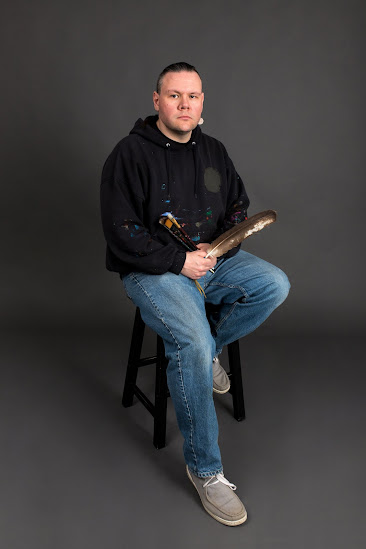
John Brady McDonald is a Nehiyawak-Metis
writer, artist, historian, musician, playwright, actor and activist born and
raised in Prince Albert, Saskatchewan.
He is from the Muskeg Lake Cree Nation and the Mistawasis Nehiyawak. The great-great-great grandson of Chief Mistawasis of the Plains Cree, as well as the grandson of famed Metis leader Jim Brady, John’s writings and artwork have been displayed in various
publications, private and permanent collections and galleries around the world,
including the Canadian War Museum in Ottawa.
John is one of the founding members of the P.A. Lowbrow art movement,
and served as Vice President of the Indigenous Peoples Artists Collective for
nearly a decade. John also served a term as vice-chair of the Board of
Directors for Spark Theatre, and as a Senator with the Indigenous Council
Committee of CUPE Saskatchewan.
John is the author of several books, and has had his written
works published and presented around the globe.
John has studied at England’s prestigious
University of Cambridge, where in July 2000 he made international headlines by
symbolically ‘discovering’ and ‘claiming’ England for the First Peoples of the
Americas. John is also an acclaimed public speaker, who has presented in venues
across the globe, such as the Anskohk Aboriginal Literature Festival, the Black
Hills Seminars on Reclaiming Youth, The Appalachian Mountain Seminars, the Edmonton
and Fort McMurray Literary Festival, the Eden Mills Writers Festival and at the
Ottawa International Writers Festival. John was honoured with the opportunity
to speak in Australia in April of 2001.
John was also included in the Aboriginal Artists and Performers
Inventory for the 2010 Olympic Winter Games in Vancouver, BC.
John’s artwork and writing have been nominated for several
awards, including the 2001 Saskatchewan Aboriginal Youth Achievement Award.
John was awarded the 2017 BOB Award for Best Artist. He has been honoured with
several grants from the Saskatchewan Arts Board.
A noted polymath, John lives in Northern Saskatchewan.
1 - How did your first book change your life? How does your most
recent work compare to your previous? How does it feel different?
My first poetry collection, The Glass Lodge was
actually both a blessing and a curse. I was a young, brash, still relatively
angry young man from the ‘hood when I wrote it, and after spending a few years
trying to get it published without success, to have it finally published and
then to have it go out on tour and take me across Canada and into the US
broadened my world beyond the small, isolated life I was living. I suddenly
found myself sharing stages with people like Drew Hayden Taylor, Lee Maracle
and Margaret Atwood. I was rubbing elbows with some of the most intelligent
people I had ever met in my life, being feted and treated like some sort of
wunderkind Indigenous poet on the scene. My name was getting out there and
being noticed by other Indigenous writers, and I fully admit that it went to my
head. I loved flying to literary festivals, staying in hotels, doing readings
and book signings. I felt like I was somebody important. For the first time in
my life, I felt acknowledged and respected. However, when the forward momentum
of it petered out as quickly as it did, the rejection letters for my new work
started piling up again, and my fifteen minutes was over, it was a very
crushing, very humbling, yet very educational experience, and there were many
times when I very nearly quit writing altogether. I’m forever grateful for The
Glass Lodge, but it caused as much grief as it did joy.
Both of my new collections, Childhood Thoughts and Water
and KITOTAM, come from the same desire to chronicle and express my
emotions and experiences as an Urban Indigenous man living in this rapidly
disconnecting society. However, I feel that, as I have gotten older and have
moved away from the angry young man of my youth, the poems take on a somewhat
more wistful look back on my life. The new work has also allowed me to be a bit
more creative and experimental with my words, toying with themes that are
beyond simply, “This happened, and this is how I feel about it.”
2 - How did you come to poetry first, as opposed to, say,
fiction or non-fiction?
I came to poetry as a failed singer-songwriter. I’ve played
music off and on for many years, more off than on, and early on I was always
trying to emulate the music I was listening to and trying to play, which was
the angst-filled jaded music of Grunge and Generation X. Many of my early poems
started out as the lyrics and choruses of songs I was writing, and I had
envisioned myself one day being a Neil Young-like figure, some scruffy cat
sitting with a battered guitar singing my words to patrons in smoky dive bars.
Luckily for me, life took a different path. I began to discover that the words
and lyrics I was writing were pushing against the constraints of a rhyming
verse-chorus-verse -bridge-chorus-coda structure, and they began to grow and
expand into longer pieces of dialogue that were better delivered as spoken
word. It was around this time that I also began to discover the free-verse Beat
Poetry of writers like Allen Ginsberg and Jack Kerouac, and, when I moved away
from structured writing, I felt more fulfilled artistically, while at the same
time I felt a greater sense of freedom. My poems could be as long or as short
as they needed to be, and I could create a greater emotional connection with an
audience via spoken word, far greater than I could with longer fiction or
non-fiction.
3 - How long does it take to start any particular writing
project? Does your writing initially come quickly, or is it a slow process? Do
first drafts appear looking close to their final shape, or does your work come
out of copious notes?
I never really start out with a completed project in mind.
More often than not, the pieces that end up in my poetry collections will first
see the light of day as live performance spoken word pieces, read direct to the
audience. I’ve always gauged my work by how it plays live, and then I can edit
and tweak to ensure that what I am saying is connecting with the listener. When
it comes to my most recent published collections, many of the poems go back
twenty years, and were just waiting for the right pieces to go alongside them
in a collection. The words themselves may come quickly enough to perform live,
but to accumulate enough of them takes time. That being said, when the
inspiration hits, or when there is a message that needs to be addressed quickly,
such as in the case following the murder of Colten Boushie, I can create a
performance piece or a spoken word set that translates into a large chunk of a
collection. I tend to try write as modular as possible, which gives me the
ability to pull and add pieces here and there to make the pieces fit more
cohesively.
4 - Where does a poem usually begin for you? Are you an
author of short pieces that end up combining into a larger project, or are you
working on a "book" from the very beginning?
I am in a constant state of creating, writing down little
snippets of ideas as they come to me, adding to it here and there, and so on.
More often or not, I will think of a phrase or a line, walk around for a while,
saying it over and over again, trying to commit it to memory, and then, when I
sit down to actually write it out, it flows into a complete poem or piece of
prose, building a flow around the anchor line or phrase. I will write on little
scraps of paper or torn out pages from notebooks, then I throw them into a
cardboard shoebox on my desk. When the box is full, then I start looking at the
pieces as possibly a complete manuscript. I start culling what doesn’t fit with
the general overall theme of what’s in the box. I am not sure that I would ever
be comfortable setting out to write a poetry book cover to cover from page one.
My style of poetry hardly seems conducive to that type of setup, and I would be
worried that such a book would seem artificial and disingenuous, given the
subject matter I am often addressing.
5 - Are public readings part of or counter to your creative
process? Are you the sort of writer who enjoys doing readings?
I absolutely thrive on live public readings. As a free-verse
beat poet and spoken word artist, from a creative point of view, I need to
perform my work before audiences, as I use it to see whether what I have to say
is making an impact as a storyteller. Performing live is instant gratification,
and it is the proving ground for the strength, validity and overall value of
the poems. I’ve written pieces that, on
paper, I was absolutely sure were amazing pieces, only to have them crash and
burn live. Live readings also allows me to edit on the fly. The setup on a
piece of paper might look okay, but then, when you get on the stage and try to
perform it, you discover that the words don’t flow as nice as they did on the
paper, and you end up stumbling over them, getting tongue-tied and looking the
fool. On a personal level, I love that feeling when you look out into the
audience and you see and hear the fingers snapping, the nodding of heads, and
the eyes staring at you and not their phones. It is powerful medicine for a
performer. It is a sacred ceremony to me, the creating of a moment between
storyteller and audience, creating a spiritual connection that goes back to
time immemorial when our ancestors gathered around fires to share stories. As
the Global Pandemic has progressed, I have discovered how much I dislike doing
readings over platforms such as Zoom. They are so impersonal and distant, and
there is not that energy of an audience to feed off, not like there is when you
are in the same room with someone. The emotional connection is lost over the
internet, and the energy and magic of the piece is strongly lacking. It’s like
the old saying about being able to play the blues but not feeling it. I cannot
wait until we can do live readings again.
6 - Do you have any theoretical concerns behind your writing?
What kinds of questions are you trying to answer with your work? What do you
even think the current questions are?
As Indigenous artists, we are responsible for ensuring that
the perspectives, issues and stories of our people are brought forward and
shared in such a way that society is reminded of our unique position in this
country, and the role that this society has played upon where we all are now at
this point of history. That being said, too often in the past, there is/was the
mistaken belief/stereotype that every single piece we create as Indigenous artists,
be it visual art, literature, performance, etc., needs to have its entirety
based upon Indigenous imagery, culture and tradition. I found myself early on
chafing against what I often referred to as the “Buffalo Skulls and Eagle
Feathers” style of art. I was trying not to be pigeonholed into what gets
labelled as “Indigenous Art.” This went with my writing style, as well. For a
long time, my poetry and performance art strayed far from the narrative of
Indigenous issues, not out of a sense of cultural or personal shame, but out of
a sense of trying to free myself from what I felt was artistic restraint and
limitation. Truth be told, I was still young, naïve and undisciplined in my
craft, and I needed to be humbled enough to see the path I needed to be on. I
needed to see what I was doing as something serious, and not as a mere trifling
diversion. I needed to understand my role as a warrior, and the role I have to
play as an Indigenous artist.
As events across Canada continue to cause massive change and
turmoil, as people fight harder than ever to defend and protect Indigenous
rights, the land and water, Indigenous identity and sovereignty, and as the
issues of the true extent of colonization, cultural appropriation, racism and
genocide are brought to the surface, the role of the Indigenous artist as a
protector of the People, the storyteller, the defender and the voice for those
no longer here to share their stories has never been more important. We as
Indigenous artists have all had to step up and add our voices to the growing
calls for truth, recognition and basic human rights. The crafts we have been
given as creators of art are powerful spiritual medicines, and they are proof
that the decades of Residential School, the decades of oppression, the decades
of racism and violence have not succeeded in silencing us. When I write, I do
so with the mindfulness that I am adding my voice to the masses fighting for
change, and that I need to do my best to ensure that I am writing to enlighten,
to educate, to entertain and to heal.
7 – What do you see the current role of the writer being in
larger culture? Does s/he even have one? What do you think the role of the
writer should be?
I think that the current role of the writer in today’s
society is one of fighting what can often seem like a losing battle, while at
the same time creating some of the most amazing written works of the past 60
years. We live in a society with severe emotional disconnect and an ever-shrinking
attention span, roughly around the length of a TikTok video, and we are
competing with these stupid little electronic devices in our hands, these
addiction-driven balls and chains, tying us to our social media accounts at all
times. At the same time, the need for articulate, educated, well read and
well-versed individuals has never been greater. I remember seeing a post online
juxtaposing the scientists in 1999 with scientists of today, with the
scientists from back then saying, “We’ve cloned a sheep! We’ve landed on
Mars!”, and the exasperated scientists of today saying, “for the last time, the
earth is Round.”
The world has become a hostile place to the world of books.
The nearest city to where I live no longer even has a bookstore. The nearest
bookstore is nearly two hours away in Saskatoon.
As deeply depressing as this is, I feel that we as writers
are still bound by our craft to create work that will continue to educate,
entertain and, above all, cause the reader to have an emotional reaction, to
remind them that they are a living, breathing human with primal emotions that
go beyond a heart emoji. I work in elementary education during the day, and I
am very delighted to see the students still accessing the school library, still
taking out stacks of books from their favourite series and voraciously reading
them cover-to-cover, then returning to beg the librarian for more. I will
forever be grateful for the authors of the Dog Man series, the Big Nate series,
the Captain Underpants series and the Diary of a Wimpy Kid books for keeping
the love of reading alive within our children. We as writers continue to be the
candle in the darkness, keeping the flame lit not matter how hard YouTube and
TikTok videos try to blow them out.
8 - Do you find the process of working with an outside editor
difficult or essential (or both)?
For me, working with an outside editor can be wonderful or
difficult, depending on the editor. One can become like an overprotective
parent when it comes to our manuscripts, and the thought of handing them over
to what can be a complete stranger can be nerve-wracking, and it leaves you
feeling extremely vulnerable. I’ve worked with some amazing editors, and I have
worked with absolute butchers, and, in thankful retrospect, I’m glad that the
butchered manuscripts never saw the light of day, because they were ghastly
shells of what I have written, mangled beyond my recognition solely to ship
units. As a spoken word artist, I always hope that any potential editor can
come to one of my performances and see the original environment for which the
pieces were created, and witness the original way in which they are intended to
be read. By this, I hope that they will have a better understanding of how the
poem is to be presented on the page. I have always found that the best editors
are people who have been published, and who have been on the receiving end of
criticism and critique themselves. It provides an empathetic bedside manner
that makes it a more personal and meaningful journey to telling a better story,
and not just, “how can we make this sell more books.”
9 - What is the best piece of advice you've heard (not
necessarily given to you directly)?
One of the best pieces of advice I ever heard in terms of creating
was “don’t try to shock people for the sake of being shocking.” I have seen a
lot of pieces written where the poet was intentionally trying to shock the
reader, using way too much profanity, writing exaggerated violent scenes,
referencing vile or repulsive actions and behaviour, and exploiting the pain
and trauma of others solely for the sake of causing a reaction in people,
without care to the audience or the reader in terms of trauma or triggers. I
have always taken my cue from the Elders when they speak: leaving long,
pregnant pauses between their words, carefully thinking about what they are
about to say and what it will do to those who hear it, because the Elder must
take responsibility for it once it leaves their mouths. The world and the
issues I write about are shocking enough in and of themselves, without me
having to add to the pain. We are to take our readers on a ride through our
words, and there’s no need to constantly threaten to drive the car off a cliff
just to keep the reader interested. One must be mindful of what others have
gone through, and, as I have said many times, people should not have to suffer
re-victimization as a sacrifice to the Altar of Artistic Expression.
10 - How easy has it been for you to move between genres
(poetry to visual art)? What do you see as the appeal?
Very early on in my adult life, someone hung the label of
“polymath” around my neck, because I am able to transition easily from
situation to situation with relative ease, adapting and gaining a strong enough
knowledge base and skill set to make somewhat of a success out of whatever I
try to do. I say this not to boast or brag, but my ability to adapt, learn,
perform, retain and teach others about many different subjects is something
which I have am very honoured and fortunate to possess, as there have been
times in my life where this ability has meant the difference between paying the
rent or starving.
I have been blessed and consider myself very fortunate to
have had the opportunity over my career to try my hand at theatre, film and
television roles, music, academia, visual arts, dance and literature, and in my
personal life, I have gone from roadie to front line street outreach worker to
firefighter to historian to educator to an elected Labour Union Senator. I have
tried to meet each new role and new experience with the same amount of pride,
determination and desire to do my best as I always have, while at the same
time, filling my toolbox as much as possible.
The appeal of being able to do this really boils down to the
fact that, if something needs to be done, or someone is in need of assistance,
I can offer to help, using the tools that I have acquired, not for glory or
accolades, but just because it is the right thing to do. As a multidisciplinary
artist, these transferable skills are vital to ensure that the output of
creative work can be appreciated by those coming from all different
disciplines. I would hate that anyone ever feel left out by my work.
11 - What kind of writing routine do you tend to keep, or do
you even have one? How does a typical day (for you) begin?
I am either lucky or unlucky to be what is referred to as the
“Sleepless Elite.” This is a minuscule segment of the population who require
less than five hours of sleep a night. If I sleep longer than six hours in a
night, I wake up feeling absolutely ill, similar to a hangover. As a result, my
writing takes place entirely at night between the hours of 11:00 PM and 2:00 AM,
long after my household goes to sleep. I make a pot of tea, turn on some soft
background noise, and begin to write, compiling the little bits of flotsam and
jetsam into a stream of coherent consciousness, if I can. By 3:00 AM, I usually
fall asleep, then I am up at 6:00 AM for work.
In terms of routine, over the past few years, I have been
experimenting with the Dadaist Cut-up technique, much like William S. Burroughs
was doing in the 1960s. I acquired a 1960s Commodore typewriter, typing a
phrase or two whenever I think of one or whenever I walk by it. There is no
structure, no context, no connections between them. Some are a few lines long,
while others can be a paragraph or more in length. When I fill a sheet of
paper, I cut it into its modular segments, then I try to create a poem out of
the pieces. By doing this, I have been creating Avant Garde, experimental beat
poetry, trying to harken back to the days of the Greenwich Village Coffee
Houses of the 1960s.
One of the hard and fast routines which I have always done is
to basically commit my poems to paper or computer at least three times. Each
work starts out as a random scribble on a piece of paper, which I will compile
into a longer, handwritten piece. This is then entered into my computer as a
word document, with the various “shoebox” papers eventually creating a
manuscript. The last process is to once
again write each and every poem by hand into black, hardcover notebooks. Every
poem or performance piece I have ever created has been meticulously written
into these little 112-page hardcover notebooks from Staples, which line one of
the bookshelves in my office. The reason behind this goes back to when I was a
frontline youth outreach worker, working at a drop-in youth centre in the
downtown core of Prince Albert, Saskatchewan. I was encouraging the youth who
came to the centre to journal and write down their thoughts and experiences, to
use writing as an emotional and creative outlet for the pain and trauma that
they were experiencing. There is a spiritual, emotional reverence to a blank, hardcover
notebook, and the youth were drawn to them, they took care of them, and they
filled them up very quickly. So, I kept supplying them with these little black
books. To this day, my former clients still thank me for introducing them to
the medicine of writing and the little black books. I always want to honour
those youth today by continuing to use those books in my own writing, to
remember that I too once came from such a situation and used writing as a way
to cope with it all.
12 - When your writing gets stalled, where do you turn or
return for (for lack of a better word) inspiration?
One of my artistic influences is the early 20th
Century landscape artist Tom Thomson. He drew his inspiration from the waters
and land around Canoe Lake in Ontario’s Algonquin Park. I have always been
fascinated by the story of Thomson, from his amazing catalogue of work, to his
mysterious death in July 1917 in the waters of Canoe Lake, and the mystery
surrounding his final resting place. Like Thomson, I too draw my inspiration
from the waters and lands of a park. In my case, it is Prince Albert National
Park, approximately 80 KM north of my birthplace of Prince Albert,
Saskatchewan. I live less than a half hour drive from the park boundary, in the
northern boreal forest of Saskatchewan, and I am a regular and frequent visitor
to the Park and to its townsite, Waskesiu.
Although I spent most of my life within driving distance of
the Park, I had never actually been there until I was well into my 20s. It is
my “Happy Place,” and it is where I go to sit beside the frigid waters of
Waskesiu Lake, to wander the trails through the untouched boreal forest
ecosystem, and to recharge. In our culture, when we want to get grounded, we
literally go to the ground. We draw our spiritual and mental healing and
medicine from the land and the water. It is sacred to us, and we continue the
interconnectedness as Stewards of the Land even to this day.
13 - What fragrance reminds you of home?
There are many smells which remind me of home. The one that
most takes me back is the smell of rain upon the wet pavement on a summer’s
day. I am immediately taken back to a day when I was 11 or 12 years old, just
after a summer thunderstorm, as the sky to the east was dark and grey as the
stormclouds moved eastward, while the sun in the late afternoon sky reflected
off the wet pavement and grass, even off the beads of rain upon the cars. The
smell of rain on pavement puts me back into the orange rays of a setting sun as
I walked down the busy streets, heading nowhere in particular. It is the one
scent that anchors me to a specific time of day at a specific moment in my
life.
14 - David W. McFadden once said that books come from books,
but are there any other forms that influence your work, whether nature, music,
science or visual art?
My first influence has always been, and will always be,
music, As a poet, my biggest influences are those poets that just happened to
be musicians. I have been deeply influenced by the written works of Leonard
Cohen, Patti Smith, Jim Morrison, Joni Mitchell and Neil Peart, the lyricist
for the band RUSH. The books of Leonard Cohen and Patti Smith still rank as
some of my greatest sources of inspiration.
I am also deeply influenced, as sad as it is to admit it, by
the horror, negativity, vitriol and reality that is often on full display upon
social media and in the news. A large portion of what I have written of any
substance over the past few years has been in response to, and in some cases,
the defense of, things that have been posted on Facebook, such as the continued
efforts of Land and Water Protectors across the country, as well as the
horribly negative and racist commentaries when it comes to Indigenous issues.
Some of the most evocative words I have created over the past four years have
been born out of online Facebook arguments with trolls and racists. I take
comfort in the fact that some good has come out of these verbal jousting
matches in that, while I might not be changing their already made-up minds, I
can take the words I have written, and expand upon them at greater length
elsewhere.
15 - What other writers or writings are important for your
work, or simply your life outside of your work?
That is a really tough question to answer, as the majority of
my reading as of late is done more out of a research sense than as recreation
or entertainment. Outside of the poets I mentioned earlier, I have rather
enjoyed the work of Saskatchewan author and historian Bill Waiser, who has
written extensively on the history of Saskatchewan. I have also been a longtime
reader of my friend Harold Johnson, who has written several amazing books as of
late addressing such topics as addictions in First Nations communities and the
biases and incompatibility of the Canadian Justice system when it comes to
Indigenous people. I also adore the “Hitchhikers Guide to the Galaxy” books for
their sheer absurdness and imagery.
I fully admit to a
guilty pleasure, however. My go-to books when I am reading to unwind or to
disconnect from the real world are British “locked room” or “cozy” mysteries. I
absolutely love the works of Agatha Christie, M.C. Beaton, and Caroline Graham.
I have set a goal to read my way through the entire British Library Crime Classics collection one day. They are cheesy, simple, wonderful books from an
earlier time, which provide me with a joy which is difficult to describe as to
why. They are short enough that I can take one or two of the books to the
beach, or curl up with one in the afternoon and be finished before suppertime.
Some people read Harlequin Romance, some read Zane Grey, while others read true
crime paperbacks. I love my little mysteries, where the butler rarely, if ever,
does it.
16 - What would you like to do that you haven't yet done?
I have been blessed to have so many of my dreams and goals
come true, from having my work be part of high school curriculum to having my
name recognized alongside so many of my idols. In spite of it all, I would
still like to see my work one day win some of the major literary awards in this
country, like the Giller Prize and the Griffin Prize, perhaps even the Governor
General Award. I want to be able to show that, in spite of unbelievable amounts
of rejection, self-doubt and the Fear of Missing Out, goals can be achieved by
those who set out determined to meet them, no matter how lofty they are or
where you came from. As a Residential School survivor, I have experienced first
hand what its like to have your spirit crushed and what it’s like to made to
feel as if what you are and who you are is not good enough. To win big awards
would be, for me, the ultimate vindication, for it would prove every single one
of those people wrong.
17 - If you could pick any other occupation to attempt, what
would it be? Or, alternately, what do you think you would have ended up doing
had you not been a writer?
I had actually, at one point early on, had my heart set on
joining the military, following in a long line of family members who have
served in the Armed Forces. I had gotten as far as meeting with a recruiter in
Edmonton to begin the process of joining the Princess Patricia’s Canadian Light
Infantry. Alas, the fact that I cannot swim put an end to my dream of a
military career. I had also had aspirations of becoming an Elementary School
teacher, but could never secure the funding to do it. That being said, my 20-year
career working with youth, including the last ten years as an Educational
Associate in an Elementary School has been the most rewarding and fulfilling job
I could ever ask for. If I had to pick
another career, I would absolutely see myself living in some quaint little
English village, running a small bookstore or tea shop, perhaps teaching at a
university somewhere, then returning home to a cozy little Tudor cottage to
warm myself before a fire. My wife and I are devotees of the British mystery
series Midsomer Murders, and, having experienced quaint pastoral English life
firsthand while at Cambridge, I would love to live that quiet, stereotypical
rural English life.
18 - What made you write, as opposed to doing something else?
I think that the major reason I became a writer was to find a
better solution to addressing and releasing the emotional pain and trauma I had
experienced. In my early teen years, I became heavily addicted to drugs and
alcohol, trying to mask the pain of my childhood and the world around me. The
ability to vent that pain onto paper, as opposed to numbing it with substance
abuse, allowed me to finally begin the healing process, and to address the
trauma of my Residential School experience. If not for the ability to string
words together in a legible and understandable way, I would have rather quickly
found myself an early grave due to the destructive life I was leading. I am
forever fortunate for the gift of writing. It has truly saved my life.
19 - What was the last great book you read? What was the last
great film?
The last great book I read was Cold Case North, by
Deanna Reder, Eric Bell and Michael Nest, and published by University of Regina
Press. It is the true story of the recent search for the remains of my
grandfather, James Patrick (Jim) Brady, and Absolom Halkett, who disappeared in
June 1967 in Northern Saskatchewan. My grandfather was one of the most
influential Metis leaders of the 20th Century, and his disappearance
while in Northern Saskatchewan spawned decades of mystery, conjecture and
conspiracy. The book chronicles the underwater search for the remains of the
two men at the bottom of a northern Saskatchewan lake, and addresses the
circumstances surrounding his disappearance. My grandfather vanished 14 years
before I was born, so I never got the chance to know him, but his life is the
example by which I live every single day, and this book provided me with a
clearer vision of who he was and what had happened to him.
I must admit that, when it comes to films, I rarely watch new
releases or summer blockbusters. I am extremely disinterested in anything that
is popular among the masses or in theatres. I rarely go to the theatre, even
before the pandemic. My tastes run to older, black and white films, a lot of
film noir, Hammer Films, Basil Rathbone as Sherlock Holmes, Vincent Price in
pretty much anything, Tim Curry in pretty much anything, etc. Of course, I’m
also a major viewer of documentaries, and the majority of what I watch are
documentary films.
The last great documentary film I watched was There Are No Fakes, which tells the story of Kevin Hearn, from the Barenaked Ladies, who
purchased what he thought was an original painting by the Woodland artist Norval Morriseau. It turns out that the painting is a forgery, and the film quickly
spirals into the world of a massive art forgery ring, the likes of which is
unprecedented in the Canadian Arts world. It was a sobering and chilling
documentary.
20 - What are you currently working on?
I am currently working on a collection of nonfiction essays
pertaining to many topics concerning contemporary Indigenous issues, as well as
anecdotes from my experiences in 21st Century Western Canada.
I have also just filled up the shoebox on my desk again, which
means that I will be blocking out another poetry manuscript sometime soon. We
shall see what shape it takes.
12 or 20 (second series) questions;