Showing posts with label After Hours Editions. Show all posts

Sunday, July 17, 2022

Colleen Louise Barry, Colleen


This is a surface
I am reflected on
No surface
 

Am I reflected

I make so many mistakes with green beans 

This is just today

I am sitting while the wind does whatever
To the house and my banner whips around

A chained up snake in the garden
A furious human wig (“This Is a Mirror”)

Having read a recent interview with her [as well as her recent ’12 or 20 questions’ interview], I was curious about Seattle, Washington visual artist, writer and teacher Colleen Louise Barry’s full-length poetry debut, Colleen (New York/Kingston NY: After Hours Editions, 2022). Barry writes a kind of lyric accumulation of direct statements that assemble into larger structures, offering a book of perception, curiosities and alternate voices. “The truth is a part of age,” she writes, to open the poem “Never Done Quitting,” “is just not about your body // Elegance is rigid / over there, a horizon // the hawk flies over / It is just hungry // to be around you [.]” Composed via the shorter, first-person lyric, Colleen suggests itself as a book entirely around voice, but variations around a singular, central point. Who is this “Colleen” the author writes about? Barry composes lyric monologues that meander and click together across the open space of both thought and the physical page. “The color curtsies into space.” she writes, as part of the poem “Route B43,” “It’s the newest year / in a series of years. / Starting now / it’s my appropriate season.” Hers is a poetry of small moments, even gestures, that connect to form larger portraits and shapes, often not exactly what one might expect, upon opening. “I was so lonely so I bought a fish,” she writes, to open “My Fish,” “I was so lonely // In the night I don’t know what my fish thought / I dreamed of water only [.]” Composing poems of observation, distance and boundaries on birds, fish, lawns, motion and suspension, there are moments her poems seem to be composed from the outside, looking in. “When does the middle part begin?” she asks, to open the poem USA IV,” “Actually, you’re at the end / with a bunch of beautiful drunk people / stepping over ice.” Is it possible for the lyric to be simultaneously cinematic and internal? Possibly, if one is experiencing Colleen.

Regularly Maintained American Lawns

I was driven wild with trespassing
Bodies I never figured out
How to ingratiate
 

That is this that and the other thing:
Love and what a slowly fading sparkle
I much prefer
 

The muted shock cardinals harry
in early-mid March snow
on my lawn of all

the regularly-maintained American lawns

Thursday, June 23, 2022

12 or 20 (second series) questions with Lawrence Giffin

Lawrence Giffin [photo credit: Michael Ian] is the author of several books of poetry, including Untitled, 2004 (After Hours Editions, 2020), Plato’s Closet (Roof Books, 2016) and Christian Name (Ugly Duckling Presse, 2012). He is a co-editor at Golias Books.

1 - How did your first book change your life? How does your most recent work compare to your previous? How does it feel different?
My first book, Christian Name, changed my life in two ways—for the better, because I was finally done with it and done wondering whether or not I was really a poet, and for the worse in that it fooled me into believing I really was poet.

Certainly, publishing has nothing to do with being a poet (I’m unclear how one is ever a poet when not actively writing a poem); still, as meaningless as it is, it really is everything. As far as how my work has changed, I’m not sure I’m the best judge, since I can only describe my side of it. There is a greater desire to say “something real,” but also a greater suspicion as to the very possibility. There is a greater fear of turning out to be a bullshit artist and greater recognition that likely this is the case. Does any bullshit artist think of themselves as such? The value recognition of praise, even simply in the form of a publisher’s willingness to print it, inevitably diminishes, and one is forced to reckon with the various motives, noble and ignoble, that have been driving one’s practice for so long, often unconsciously, and which now may appear shameful or misguided. This revaluation generally has a positive effect, but it is equally painful and frightening.

It’s good to have something else to fall back on. Adam Phillips tells a story of a poet who told him it’s good for poets to have day jobs, “otherwise they start to believe that they really are poets.”

2 - How did you come to poetry first, as opposed to, say, fiction or non-fiction?

I didn’t. I tried my hand at fiction first, but I wasn’t very good at it, and I didn’t have the smarts or attention-span to write non-fiction or, god-forbid, philosophy, so I became a poet. I have a hard time putting myself in the reader’s shoes, and poetry rewards that.

3 - How long does it take to start any particular writing project? Does your writing initially come quickly, or is it a slow process? Do first drafts appear looking close to their final shape, or does your work come out of copious notes?
If the work comes at all, and it does, though rarely, it comes out fairly close to its finished form. For me, if a poem requires heavy revisions, it’s because something isn’t working on a fundamental level—in my case, usually, it’s trying to do too many things at once, without a cohesive frame—and quickly falls apart under the tiniest of revisions.

4 - Where does a poem usually begin for you? Are you an author of short pieces that end up combining into a larger project, or are you working on a "book" from the very beginning?
I begin by writing. It always begins with actually writing something, whatever, on and on—abandoning some poems, returning to others, starting over—until something takes, that is to say, a line or a phrase, some actual string of words, seems to me compelling and generative, and then I follow that until I get bored or feel like it’s over. It doesn’t mean that what I write will be any good, only that I have to stumble on it—I can’t plan it out ahead of time. I hardly ever come to the page with an idea or theme. I always have to start with some bit of text that happens to evoke more text.

I rarely set out to write long poems or short poems. Since I never set out to write this or that kind of poem to begin with, it’s equally unknown ahead of time how long a particular poem would be. I’d like to try writing shorter poems because I think most people prefer to read less rather than more.

5 - Are public readings part of or counter to your creative process? Are you the sort of writer who enjoys doing readings?
I don’t often enjoy attending them, and rarely enjoy giving them. That said, they aren’t counter to my process any more than they are necessary to it.

6 - Do you have any theoretical concerns behind your writing? What kinds of questions are you trying to answer with your work? What do you even think the current questions are?

Nothing explicit, though I certainly have interests and preoccupations which cannot fail to give the work a vague sense of coherence. Poetry is particularly poor at answering questions (or even forming them), and anyone who tells you otherwise is trying to sell you a load of bullshit. If poetry is anything, has any being, it can’t be the sort of discourse about which questions can be posed ahead of time, as if the answers already exist and are merely waiting to be uncovered. People who look to poetry for answers to life’s most pressing questions are already beyond help.

I do think poetry can bring us into contact with our insignificance and congenital fragility without turning it into the substance of a supreme (and supremacist) nihilism, though it might do that as well (the Iliad is an example of this danger, though Thersites’ objections to the war and his subsequent humiliation gives the poem a whiff of the absurd). Poems make fools and knaves of us all, writers and readers.

7 – What do you see the current role of the writer being in larger culture? Does s/he even have one? What do you think the role of the writer should be?

Clearly the role of the poet is to assuage our fear that, really, no one knows what is going on. Poets relieve us of having to hope or believe ourselves. They believe for us, on our behalf. Maybe this answers Hölderlin’s question, “what good are poets in lean times?” They get us through rough patches by spouting reenchantment propaganda.

8 - Do you find the process of working with an outside editor difficult or essential (or both)?
Both. Neither.

9 - What is the best piece of advice you've heard (not necessarily given to you directly)?
Make mistakes.

10 - What kind of writing routine do you tend to keep, or do you even have one? How does a typical day (for you) begin?
I can’t keep any routine at all, much less one around an activity as frustrating and demoralizing as trying to write a poem. I long ago gave up on the hope that I would learn to schedule things with a sufficient level of granularity or wake up early to compose my silly little verses. As long as my kid is safe, my partner feels supported, and the laundry is done—success. Were poetry a similar prerequisite, I’d have given up long ago.

11 - When your writing gets stalled, where do you turn or return for (for lack of a better word) inspiration?
If the writing gets stalled, it’s usually because I’m trying too hard. The only way out I know is to keep writing, to stop trying to write and write, whatever comes out. Like I said, something has to take, but that something has always to be already written before I can stumble upon it. It's a dilemma, like Baron Munchausen pulling himself up by his own ponytail, and one which can be addressed only by a mad scribbling.

12 - What fragrance reminds you of home?

Foul river mud. Diesel exhaust. Casseroles.

13 - David W. McFadden once said that books come from books, but are there any other forms that influence your work, whether nature, music, science or visual art?
Philosophy, physics, psychoanalysis, evolutionary biology, game theory, algorithmic information theory, Greek mythology.

14 - What other writers or writings are important for your work, or simply your life outside of your work?

Perennially returning to Bataille, Heidegger, Schuyler, Ashbery. Have of late been reading Wittgenstein, Adam Phillips, Montaigne, Nicole Loraux, Seth Benardete, Hans Blumenberg. Diderot still manages to scandalize me. Recent poetry that sticks out includes the late Iliassa Sequin’s collected, John Coletti’s Deep Code, Josef Kaplan’s Loser, Denise Riley’s Say Something Back (reprinted by NYRB with the remarkable Time Lived, Without Its Flow), and Gordon Faylor’s Want.

15 - What would you like to do that you haven't yet done?

Inherit a fortune.

16 - If you could pick any other occupation to attempt, what would it be? Or, alternately, what do you think you would have ended up doing had you not been a writer?
Who can say? For one, writing is not my occupation, if that means what occupies the greatest amount of my time or where I get my money. Certainly, thinking I am a poet occupies great swathes of the day, but actually writing, no.

Were I not who I am—every capricious decision and accident of fate—I would be someone else, and since there are plenty of other people, I am already doing all the things I would be had I been somebody else.

17 - What made you write, as opposed to doing something else?
I’ve always found reading—holding onto an idea, following a thread, understanding the stakes—difficult. And people are a mystery to me—their motives, why some things make them happy and other things sad, why they want the things they want. I suppose writing addressed those twin mysteries and promised not only access to them but the privileged access of a poet. But such access is not truly possible, and even if it were, certainly poetry would not be the means.

I find the idea of a reader to be utterly incomprehensible, so that when I try to write for an idealized reader, the figure in my head quickly becomes monstrous, and when I don’t write for the reader, I seem to default to addressing some bitter and hateful deity.

18 - What was the last great book you read? What was the last great film?
The last great book I read was either Ann Leckie’s Imperial Radch trilogy or Liu Cixin’s Remembrance of Earth’s Past. I think Thor: Ragnarok was probably the last time I left the theater perfectly satisfied.

19 - What are you currently working on?
Either a pretentious and likely fatuous book on the uselessness and unavoidability of mythic delusion in daily life or an inspired and fascinating book on the uselessness and unavoidability of mythic delusion in daily life. Regardless, it will never see the light of day.

12 or 20 (second series) questions;


Sunday, June 05, 2022

12 or 20 (second series) questions with Colleen Louise Barry

Colleen Louise Barry is an artist, writer, and teacher based in Seattle, WA. Her first book of poems, Colleen, appeared from After Hours Editions in April 2022. More at www.colleenlouisebarry.com or @colleenlouisebarry.

1 - How did your first book or chapbook change your life? How does your most recent work compare to your previous? How does it feel different?
My first book is about to come out! I'm not sure that the fact of this book being completed and published is really a life-changing experience right now. Writing Colleen was more like a companion through change ~ not a major catalyst but a subtle process, or a container. Like a friend or a healing ritual.    

2 - How did you come to poetry first, as opposed to, say, fiction or non-fiction?
It's all mixed up. I have always been writing something in some way, painting and calling it narrative, building installations and calling them poems. My way of being in the world is making things. Language is an always accessible and infinitely rich material with which to do so.

3 - How long does it take to start any particular writing project? Does your writing initially come quickly, or is it a slow process? Do first drafts appear looking close to their final shape, or does your work come out of copious notes?
A long, long time. I allow myself to operate under zero pressure in my writing life. Colleen took six years to write with large gaps of just not writing at all, or writing only by revising. I let poems come to me however they wish. Sometimes quickly while I'm driving to the store or some such thing, sometimes piece by piece over years. I do like to try to fit lines together, images together. There's just no set way. Creativity is equivalent to flexibility and receptivity. For me, that's the thrill.

4 - Where does a poem usually begin for you? Are you an author of short pieces that end up combining into a larger project, or are you working on a "book" from the very beginning?

Making a book was never a concrete goal for me. My poems are independent little creatures. They spring up from anywhere and we get to know each other.

5 - Are public readings part of or counter to your creative process? Are you the sort of writer who enjoys doing readings?
I completely understand and respect poets who value and uphold the tradition of poetry as an oral, performative art. But for me, poems are on the page and their life is there. I really want anyone who reads my poems to get that private intimacy with them, without my intonation and timbre echoing in their heads. I do not enjoy reading my work aloud. I don't particularly even feel like the voice with which I speak out loud is the voice of the poems. Even though it was me who technically wrote the book, the Colleens in Colleen aren't really me. They could be anyone.

6 - Do you have any theoretical concerns behind your writing? What kinds of questions are you trying to answer with your work? What do you even think the current questions are?
The current questions are all the old questions, too. Can we understand how language creates our reality and can we overcome its limitations? Is it possible to create a better world with words? What is underneath words; is it meaning? What is the nature of meaning without language? Is language our bridge to truth, or is it the veil obscuring it? Why are things funny? Why are things sad? Why am I me?

7 – What do you see the current role of the writer being in larger culture? Does s/he even have one? What do you think the role of the writer should be?
The writer's role is to inform and challenge. Writers should use their material (language) to change the way people see each other and to open them to alternative understandings of their world. I think it is true that excellent writing engenders empathy ~ empathy being the most essential ingredient to our species' survival.

8 - Do you find the process of working with an outside editor difficult or essential (or both)?
I did not find outside editors particularly essential until I was ready to consider the poems in Colleen as a larger collection. I wasn't sure how to do that effectively ~ package them, order them, say confidently: these poems go together and you should buy them as such. Other than that, between myself and the poem I'm writing, there seems to be plenty of opinions already flying around.

9 - What is the best piece of advice you've heard (not necessarily given to you directly)?
Work hard with ease. Simple, true, a kind of relief.  

10 - How easy has it been for you to move between genres (solo to collaborative work, poetry to multidisciplinary work)? What do you see as the appeal?
I love and in some ways need to move between genres all the time. My work informs my other work. It's like its own little ecosystem of creativity.

11 - What kind of writing routine do you tend to keep, or do you even have one? How does a typical day (for you) begin?
I dream of being a writer with a routine. I am, however, decidedly not. I write when I get that feeling to write ~ a feeling that is hard to describe. It's like a swelling in the chest. I drift off into another mode of observing. When that hits, no matter where I am, I write the words down. I use my iPhone notes a lot, or a little spiral notebook I bring around, or sometimes scraps from my bag, or the back of my hand.

12 - When your writing gets stalled, where do you turn or return for (for lack of a better word) inspiration?
I do not stress about this much. I just work on something else, a drawing or sculpture or dinner or anything. I also love to read. Reading always inspires me.

13 - What fragrance reminds you of home?
Grass and dirt, wet dogs, a fireplace going out.

14 - David W. McFadden once said that books come from books, but are there any other forms that influence your work, whether nature, music, science or visual art?
Music was a huge part of Colleen. I love the way songs create intimacy with the listener. I also love the way a song can play over and over and over again, that it can come to mean a moment in time, that it can come to define a version of you. It's yet another reason I named the book after myself. Cher has Cher, Britney has Britney, why can't I call my debut book Colleen? (That's halfway a joke, but the serious half is very serious.)

15 - What other writers or writings are important for your work, or simply your life outside of your work?
I love any writer that can capture the absurdity of life with empathy and humor. Joy Williams, Emily Hunt, Wallace Stevens, Virginia Woolf. A certain precision with language. I love writers who know how to research. I am honestly blown away by contemporary journalists who have perhaps the most difficult job of all. They must use their writing like a weapon in defense of humanity, equality, democracy, science.  

16 - What would you like to do that you haven't yet done?
This question makes me think about a piece by Jean Chen Ho that I read in the NY Times this morning, sitting in bed with my partner and my cat and some coffee. It was about the subjunctive tense and the power of grammar. She writes: "A subjunctive mode of inquiry uses narrative 'both to tell an impossible story and to amplify the impossibility of its telling...'"

17 - If you could pick any other occupation to attempt, what would it be? Or, alternately, what do you think you would have ended up doing had you not been a writer?
I am currently a middle school art teacher at an independent school in Seattle. It's what I'm supposed to be doing and probably what I always would have done.

18 - What made you write, as opposed to doing something else?
I certainly do other things alongside writing. I love words and I love to play. I am curious about everything. And I want to communicate. I think it all just falls into line. I followed my heart to writing, as I have to almost everything else.  

19 - What was the last great book you read? What was the last great film?
My favorite recent books:
Catherine the Great: Portrait of a Woman by Robert K. Massie. Hoarders by Kate Durbin. My People The Sioux by Luther Standing Bear. We Die in Italy by Sarah Jean Alexander.

My favorite recent movies:
Licorice Pizza. The French Dispatch. Donkey Skin. Bull Durham. Into the Blue. Cutie and the Boxer.

20 - What are you currently working on?
I'm working on daily sanity, a positive outlook, a lesson plan about action painting, a novel, a series of giant and soft artist books, an animatronic ride-turned-installation called "The Love Tunnel".  

12 or 20 (second series) questions;

Tuesday, February 01, 2022

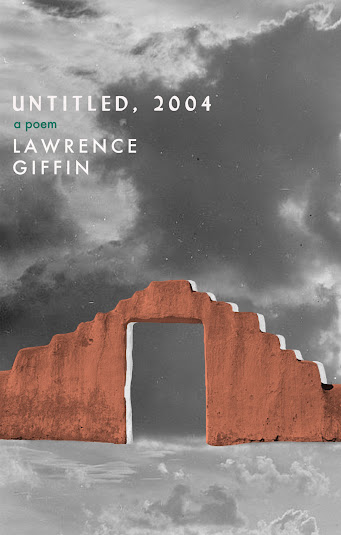
Lawrence Giffin, Untitled, 2004


October 12 or 15, the twelfth
surely, certainly 2016 that I know,
your mother and I took the train

uptown to see the Agnes Martin
retrospective at the Guggenheim,

and still a year and change before your birth,
we hadn’t thought of naming you Agnes

and wouldn’t until your mother was
well into her pregnancy with you.

Shakespeare’s wife Ann was born
Agnes Hathaway, back when

people thought Agnes was just
a version of Anna, which is not,

like Agnes, from the Greek but comes instead
from the Hebrew meaning “grace.”

And so begins the latest poetry title by American poet and editor Lawrence Giffin, the extended poem Untitled, 2004 (New York/Kingston NY: After Hours Editions, 2020). Untitled, 2004 follows on the heels of his array of previous books and chapbooks, including Get the Fuck Back Into That Burning Plane (Ugly Duckling Presse, 2009), Sorites (Tea Party Republicans Press, 2011), Ex Tempore (Troll Thread, 2011), Christian Name (Ugly Duckling Presse, 2012), Just Kids (with Lauren Spohrer; Agnes Fox Press, 2012), Ad Pedem Litterae, 3 vols. (Troll Thread, 2012), Quod Vide (Troll Thread, 2014), Non Facit Saltus (Troll Thread, 2014), White Future (orworse, 2014) and Plato’s Closet (Roof Books, 2016).

“The trouble with beginnings is / they never take place quite at the / beginning.” he writes, close to the beginning of the collection (but not actually at the beginning). There is an ongoingness to this piece that is quite interesting. Giffin composes a long poem that moves through accumulation of section upon section, layering an epistolary meditation directed at his young daughter while folding in lengthy critiques and observations on the work and life of Saskatchewan-born American painter Agnes Martin (1912-2004), as well as a wealth of elements of history, theory and memoir. There is a sense of the epic throughout Giffin’s poem, as well as something deeply intimate and personal, sketched as a diary for the young Agnes, in a book titled after an artwork by her infamous and late namesake.

I wouldn’t say you were named for
Martin, only that the name Agnes
served to mark the promise

of those early days, when
everything that had gone before

willy-nil toward an indefinite future
was roughly abridged into

a prefatory note hastily
scribbled in anticipation

of what was sure to come after.
Now we live in the relief

of waking from the nightmare where
you are yet to be born, which itself

was a nightmare, medically induced,
expectant joy debrided

into merciful deliverance.
Survival was the strait gate

through which you crammed
the contents of our world

compressed into an age-old name.

“Boredom is the desire for desire, / desire at its purest and so also, / strangely, at its most empty.” Throughout Untitled, 2004, Giffin writes on boredom, error, desire, perception, reflection and observation, folding in other elements, artworks, conversations and thoughts along the way, from St. Augustine on craft, a wealth of observations on Agnes Martin and her work, to his thoughts on “an enormous outdoor maze / by Patrick Dougherty [.]” “I walk through museums, Agnes,” he writes, “like I walk through the mall: / purposeless loafing, letting the / fantasies on offer move in / and out of my consciousness / like curtains in an open window.” There is also a particular kind of pivot he discusses, about a third of the way through the poem, citing Agnes Martin’s habit of destroying the paintings of hers that she considered imperfect or flawed in some way, not wishing to allow an artwork with a “mistake” to exist; the pivot, of course, being she did this with all of the artworks she created that she considered imperfect, but for the singular piece Untitled, 2004, […] functioning thus / as the style’s own self- / consciousness, as the fulcrum / on which her entire career / pivots back on itself. It’s / as if her seven-year break from / painting and the accompanying / break in her style is referenced / in this splotch, which becomes / a sign of that difference between / the tension of the early works / and the harmony of the later ones.” Through this, I’m uncertain Giffin’s consideration of this, if he’s attuned to this particular artwork because of its perceived flaw and is thusly connecting his own pivot-point, composing a poem on attempting perfection and the further-beauty and further-possibility of imperfection through this particular epistolary-meditation.

Giffin writes on knowing and unknowing, and the benefits of being open to both, including the arena of falling full into what might otherwise be impossible. “Agnes, I know almost nothing,” he writes, towards the end, “and it has taken me nearly / forty years to learn how dumb / I’ve always been.” He writes of first encountering the woman who would become Agnes’ mother, and the first steps of their courtship, a story that includes wandering a gallery and seeing work by Agnes Martin. “The weekend / your mother and I met, she lost / her fingertip cutting kale, / and we spent the better part of / the evening in the ER, surrounded by / bloodied Chux, with curling wisps / of lunar caustic floating up / from the wounded nail bed. / Her pointer finger even now, / years later, remains disfigured / and, no longer round, / comes to a point instead.” There is such a wonderful openness to this book-length epistolary poem, one composed with the care and attention of a new parent and a deeply considered aesthetic, one that seeks to embrace a kind of change, however uncertain those changes might be.