The Robert Kroetsch Award for Innovative Poetry
Snare Books is pleased to announce the Robert Kroetsch Award for Innovative Poetry. The prize will be awarded annually to the best poetry manuscript by an emerging Canadian writer (a writer who has published two books or less). Each year the winning manuscript will be selected by an established poet in co-operation with Snare Books. This year's judge is Darren Wershler-Henry. The winner will receive a trade paperback contract with Snare Books which will include the publication of the manuscript and a $500 honourarium. The deadline is January 31, 2007.
Each entry must be accompanied with a business size SASE and an entry fee for $30.00 Canadian. Please make all cheques payable to Livres Snare. No cash please.
About Robert Kroetsch:
One of Canada's most celebrated literary artists, Robert Kroetsch is without a doubt Canada's most important postmodern writer. His novels, poetry and theory have consistently been benchmarks for literary innovation in Canada. He won the Governor General's Award for his novel, The Studhorse Man, and in 2004, he was made an officer of the order of Canada. Snare Books is proud to honour his literary legacy through the establishment of the annual Robert Kroetsch Award for Innovative Poetry.
For More on Robert Kroetsch please visit: http://www.umanitoba.ca/canlit/bibliographies/robert_kroetsch.shtml http://www.nwpassages.com/author_profile.asp?au_id=748 http://www.athabascau.ca/writers/kroetsch.html
The Robert Kroetsch Award for Innovative Poetry
c/o Snare Books
#1A 4302 St. Urbain Street
Montreal QC
H2W 1V5
For more information check out snarebooks.blogspot.com or email jon [dot] fiorentino [at] gmail.com
Wednesday, July 19, 2006
Ongoing notes: mid-July, 2006
Did I tell you: after my posting on Kate Van Dusen (who lives in Toronto now, I found out, & not Vancouver), I got an email from her, & found out that she not only had a book out with Underwhich Editions in 1990 that I didn't know about, but she's working on a "Sex at Forty-Eight" poem, which is pretty cool. Did I tell you: after my posting on my mother + Alan Ladd (father of Cheryl Ladd, I found out, from the original Charlie's Angels…), my aunt Pam in southwestern Ontario sent me an email that included, "I really enjoyed your relating Joanne's remembrances. It was quite a thrill for her to meet Alan Ladd and his dog." Did I tell you: I reprinted a John Newlove broadside I'd done a few years back (the "DEATH OF THE HIRED MAN" poem), for the recent John Newlove documentary premiere (years of research, filming, travel & other work by Regina filmmaker Robert McTavish) at the Saskatchewan Festival of Words? (The same festival is also hosting a launch of the 30th anniversary edition of Andrew Suknaski's Wood Mountain Poems, published by Regina's Hagios Press, & a tribute to him & his work; hopefully by next year we can celebrate at least one of the three books I'm working on by/about Suknaski, whether the forthcoming selected poems with Chaudiere Books, the essays on his work with Guernica Editions, or the essay manuscript by him… do you know of something of his I might be missing, needing for any of these…?)
Did I tell you: I just had a new poetry chapbook out with Peter & Meredith Quartermain's Nomados in Vancouver? Perth Flowers is part of a longer poem, "52 flowers (or, a perth edge), – an essay on Phil Hall," that was written after Wanda O'Connor & I spent a day with Toronto poet Phil Hall & his wife Ann at their cabin in Perth, Ontario last August, & writes as both interview with him & a response to his work. The poem as a whole is part of a manuscript called "glengarry: open field" that I'm still working to get placed; built out of three long poems, including "52 flowers (or, a perth edge), – an essay on Phil Hall," "glengarry: open field, (a postscripted journal)" & "whiskey jack." Other than this new chapbook, none of the manuscript has actually seen print; what journal would want to publish anything so long? (it seems to be too much of what I've been doing lately). The new chapbook even includes a photo collage by Hall on the cover, which is absolutely cool.
Did I tell you: after my posting on what else I've been reading, I found out that Edmonton fiction writer Thomas Wharton is a comic book reader too ("I didn’t know you were a fanboy," I believe, were his words). Although he reads more DC & I read more Marvel; does that mean we have to fight? & Edmonton poet/critic Douglas Barbour told me that Planetary is far better than The Authority…
Did you notice: that Toronto poet & editor Mark Truscott responded (with a Gary Barwin follow-up) to my recent post about title-less poems? I think the idea of poems sans titles are entirely possible, but remain (I think) difficult in traditional formats of how poems are presented; is it a matter of switching formats? & honestly, if anyone could pull off poems without titles, it could be Mark Truscott, who writes some of the smartest, smallest poems around (aside from Paris, Ontario's Nelson Ball).
Windsor ON: the new issue of Karl Jirgen's RAMPIKE arrived in the mail recently, the second part of his 25th anniversary issue, featuring interviews with fiction writers Joyce Carol Oates and Alistair MacLeod, fiction by Stuart Ross, Bob Wakulich and Richard Scarsbrook, a whole swath of poetry by Roy Miki, Di Brandt, Douglas Barbour and Sheila Murphy, Christopher Dewdney, Jeff Gundy, Margaret Christakos, Rachel Zolf, myself, Carla Hartsfield and Una McDonnell, as well as inter-media by Charles Bernstein and George Elliott Clarke, and a whole pile of other things. What has always been interesting about RAMPIKE has been its range of content as well as a more international scope, from text to visuals and beyond, including a combination of all of the above, and twenty-five years is nothing to be scoffed at. How does any (basically) one-man show keep going for that long?
The next issue, which I've been waiting on for some time, features contemporary poetics in honour of Frank Davey, after the Frank Davey conference last year at the University of Western Ontario (there's also an upcoming Open Letter issue on the same).
Ottawa ON: Cornwall poet Jesse Ferguson (living in Ottawa the past few years) self-produced a little chapbook of poems for a highly successful shared reading he recently did at The TREE Reading Series with poets Nicholas Lea, Gwendolyn Guth and Robin Jeffers. Jesse Ferguson has been producing some interesting work over the past few months (from what little I've seen, and even included in things such as ottawater, winter 2 and The Peter F. Yacht Club), but the poems in his COMMUTE POEMS (Ottawa ON: Thistle Bloom Books, 2006), the first in what he hopes will be a series of books from a brand-new imprint, has a mix of both good and bad poems (I wonder if he has too many pieces out at magazines, and had little else to include in the collection). His third poetry chapbook, after Near Cooper's Marsh (Ottawa ON: Friday Circle, 2005) and Old Rhythms (Vancouver BC: Pooka Press, 2006), his COMMUTE POEMS gives some good moments in fairly uneven poems, such as in the piece "Winter in Glengarry County," including italicized lines from Al Purdy's "Winter at Roblin Lake," writing:
above/ground press will be publishing a chapbook of Ferguson's visual pieces, catch a bird (some of his visuals appeared in the most recent issue of dANDelion, as well as on the cover of Nicholas Lea's light years chapbook with above/ground), in just a couple of weeks. Watch for the reading/launch of it as part of the above/ground press LUCKY 13TH event at The Mercury Lounge on Friday, August 18th, just before Ferguson moves east to school at the University of New Brunswick in Fredericton (watch out Joe Blades…)
Did I tell you: after my posting on Kate Van Dusen (who lives in Toronto now, I found out, & not Vancouver), I got an email from her, & found out that she not only had a book out with Underwhich Editions in 1990 that I didn't know about, but she's working on a "Sex at Forty-Eight" poem, which is pretty cool. Did I tell you: after my posting on my mother + Alan Ladd (father of Cheryl Ladd, I found out, from the original Charlie's Angels…), my aunt Pam in southwestern Ontario sent me an email that included, "I really enjoyed your relating Joanne's remembrances. It was quite a thrill for her to meet Alan Ladd and his dog." Did I tell you: I reprinted a John Newlove broadside I'd done a few years back (the "DEATH OF THE HIRED MAN" poem), for the recent John Newlove documentary premiere (years of research, filming, travel & other work by Regina filmmaker Robert McTavish) at the Saskatchewan Festival of Words? (The same festival is also hosting a launch of the 30th anniversary edition of Andrew Suknaski's Wood Mountain Poems, published by Regina's Hagios Press, & a tribute to him & his work; hopefully by next year we can celebrate at least one of the three books I'm working on by/about Suknaski, whether the forthcoming selected poems with Chaudiere Books, the essays on his work with Guernica Editions, or the essay manuscript by him… do you know of something of his I might be missing, needing for any of these…?)
Did I tell you: I just had a new poetry chapbook out with Peter & Meredith Quartermain's Nomados in Vancouver? Perth Flowers is part of a longer poem, "52 flowers (or, a perth edge), – an essay on Phil Hall," that was written after Wanda O'Connor & I spent a day with Toronto poet Phil Hall & his wife Ann at their cabin in Perth, Ontario last August, & writes as both interview with him & a response to his work. The poem as a whole is part of a manuscript called "glengarry: open field" that I'm still working to get placed; built out of three long poems, including "52 flowers (or, a perth edge), – an essay on Phil Hall," "glengarry: open field, (a postscripted journal)" & "whiskey jack." Other than this new chapbook, none of the manuscript has actually seen print; what journal would want to publish anything so long? (it seems to be too much of what I've been doing lately). The new chapbook even includes a photo collage by Hall on the cover, which is absolutely cool.
Did I tell you: after my posting on what else I've been reading, I found out that Edmonton fiction writer Thomas Wharton is a comic book reader too ("I didn’t know you were a fanboy," I believe, were his words). Although he reads more DC & I read more Marvel; does that mean we have to fight? & Edmonton poet/critic Douglas Barbour told me that Planetary is far better than The Authority…
Did you notice: that Toronto poet & editor Mark Truscott responded (with a Gary Barwin follow-up) to my recent post about title-less poems? I think the idea of poems sans titles are entirely possible, but remain (I think) difficult in traditional formats of how poems are presented; is it a matter of switching formats? & honestly, if anyone could pull off poems without titles, it could be Mark Truscott, who writes some of the smartest, smallest poems around (aside from Paris, Ontario's Nelson Ball).
Windsor ON: the new issue of Karl Jirgen's RAMPIKE arrived in the mail recently, the second part of his 25th anniversary issue, featuring interviews with fiction writers Joyce Carol Oates and Alistair MacLeod, fiction by Stuart Ross, Bob Wakulich and Richard Scarsbrook, a whole swath of poetry by Roy Miki, Di Brandt, Douglas Barbour and Sheila Murphy, Christopher Dewdney, Jeff Gundy, Margaret Christakos, Rachel Zolf, myself, Carla Hartsfield and Una McDonnell, as well as inter-media by Charles Bernstein and George Elliott Clarke, and a whole pile of other things. What has always been interesting about RAMPIKE has been its range of content as well as a more international scope, from text to visuals and beyond, including a combination of all of the above, and twenty-five years is nothing to be scoffed at. How does any (basically) one-man show keep going for that long?
IntentionSome of the highlights in this issue have to be the rarity these days of seeing a new Christopher Dewdney poem, spending more of his publishing life over the past decade or so as a non-fiction writer (where has the poet gone?); or even a poem at all by Ottawa-area writer Una McDonnell; its good to finally see more of her work in print, a marvelous little poem called "The Heart's Dumb Memoir" (I think she had something previous in Arc magazine, and the second issue of ottawater; she's currently taking a summer creative writing course at UBC).
Was it your intention
to move your hand just then,
to nod, to scratch, to look
this way or that?
Or was it a confabulation
a reassurance that
you had so moved yourself
after the fact? Certainly you can
test and retest, flexing fingers,
lightening your jaw, calmly,
voluntarily. But attention recedes
and soon these willed thrusts, and more,
return to that unattended realm,
that place where the span of you,
is no more than coincidence,
a place against all odds
when you had moved your hand,
as if you actually had. (Christopher Dewdney)
The next issue, which I've been waiting on for some time, features contemporary poetics in honour of Frank Davey, after the Frank Davey conference last year at the University of Western Ontario (there's also an upcoming Open Letter issue on the same).
Ottawa ON: Cornwall poet Jesse Ferguson (living in Ottawa the past few years) self-produced a little chapbook of poems for a highly successful shared reading he recently did at The TREE Reading Series with poets Nicholas Lea, Gwendolyn Guth and Robin Jeffers. Jesse Ferguson has been producing some interesting work over the past few months (from what little I've seen, and even included in things such as ottawater, winter 2 and The Peter F. Yacht Club), but the poems in his COMMUTE POEMS (Ottawa ON: Thistle Bloom Books, 2006), the first in what he hopes will be a series of books from a brand-new imprint, has a mix of both good and bad poems (I wonder if he has too many pieces out at magazines, and had little else to include in the collection). His third poetry chapbook, after Near Cooper's Marsh (Ottawa ON: Friday Circle, 2005) and Old Rhythms (Vancouver BC: Pooka Press, 2006), his COMMUTE POEMS gives some good moments in fairly uneven poems, such as in the piece "Winter in Glengarry County," including italicized lines from Al Purdy's "Winter at Roblin Lake," writing:
the endurance of root cellars,There are moments, and there are some bad poems, but the ones that are good are pretty good, and worth the price of admission, and show just what Ferguson is and can be capable of, such as this one, about the recent Norval Morrisseau exhibit at the National Gallery (which is interesting by itself; I recently found a fragment by Toronto poet Phil Hall on the painter). From this chapbook alone, it's as though Ferguson is most effective when he keeps the poems sparse, simple.
the pride of fading usefully
and the stubble of razed wheat fields comforting as
the little golden hairs on your belly.
NorvalI look forward to what he produces next, whether as chapbook or something further, and hopefully whatever does happen, has at least someone else's eyes to go through first, before it appears. To find out about getting a copy of COMMUTE POEMS, or to hear more about the future of his Thistle Bloom (he says he wants to eventually start publishing other poets), email Ferguson at fergusonjesse@hotmail.com
Morrisseau's solution
is sophistication, simply put
countless spirit birds screeching
sophistication's dilution
in other words, wordlessly
cutting the crap
and grandfather clausing
into the jetstream of archetype
or better yet, into a water stream
because water lasts
and scoffs our brief
reifications
his paintings tell us
there are no new pigments
these fish in fish in birds
are always cutting
to the chase and chasing
each other into otherness
like Norval's fingers
when a brush was too clumsy
for his thick paint
or not clumsy enough
above/ground press will be publishing a chapbook of Ferguson's visual pieces, catch a bird (some of his visuals appeared in the most recent issue of dANDelion, as well as on the cover of Nicholas Lea's light years chapbook with above/ground), in just a couple of weeks. Watch for the reading/launch of it as part of the above/ground press LUCKY 13TH event at The Mercury Lounge on Friday, August 18th, just before Ferguson moves east to school at the University of New Brunswick in Fredericton (watch out Joe Blades…)
Sunday, July 16, 2006
Rory, etcetera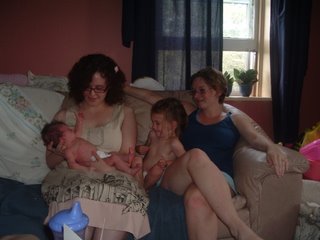
Jennifer & Kate & I drove down to the farm yesterday, to see what my sister's new baby, Rory, looked like. Here's a photo I took while we were there (from left to right): my daughter Kate (15 1/2) holding her cousin Rory (11 days old), Rory's sister Emma (2 1/2) & my sister Kathy. Apparently Kate & I are going down to the farm again for a week, just before the August long weekend, for (perhaps) the Glengarry Highland Games, my sister's annual day-long bbq, & to help out with Emma while my sister recovers.
& then late last night, stayed up far too late watching Wim Wenders' Until the End of the World (1991). Easily my favourite film (Smoke is another favourite…), but its three & a half hours long, & didn’t even start until 11:45pm (but Wenders, who also did Faraway, So Close, Wings of Desire, Million Dollar Hotel & Paris, Texas, is genius). Apparently it was co-written by Peter Carey, which makes me want to at least see what his writing is all about; is there anything in particular I should start with?
Saturday, July 15, 2006
setting stone
a weight; a concentrated northern rime
of fibre-optic burn
where northern goes; a treelined blur
landscape rocky melt of colours drop canadian shield
a weapon held
or to be; precambrian drift, lake huron heat
a lungful lug & long collapse; if nothing shadows season lengthy long
an alphabet its stations of the cross; an alphabet its stations
a pressure etching back, a stones throw; barring depth
untended; a shape of sedentary skin
circling flesh; a pleasure pulled apart
or lidless, lipless, crush; a hard place, waiting cast
what crude pretended, decimated; by thousands & our tens
of thousands
forget-me-not; a splintered shore a cabin brace
I am hopelessly beyond; tough skin or lodestone ribbed
a feet of grey grass, shouldered concrete
am mealy-mouthed, besieged
Harvest of shadow
open so sleep will last
— Phil Hall, Old Enemy Juice
a weight; a concentrated northern rime
of fibre-optic burn
where northern goes; a treelined blur
landscape rocky melt of colours drop canadian shield
a weapon held
or to be; precambrian drift, lake huron heat
a lungful lug & long collapse; if nothing shadows season lengthy long
an alphabet its stations of the cross; an alphabet its stations
a pressure etching back, a stones throw; barring depth
untended; a shape of sedentary skin
circling flesh; a pleasure pulled apart
or lidless, lipless, crush; a hard place, waiting cast
what crude pretended, decimated; by thousands & our tens
of thousands
forget-me-not; a splintered shore a cabin brace
I am hopelessly beyond; tough skin or lodestone ribbed
a feet of grey grass, shouldered concrete
am mealy-mouthed, besieged
Friday, July 14, 2006
Ongoing notes: blog on blog action
Lately I've been going through various writers' blogs (predominantly Canadian writers, and poets at that…) to see what it is they're doing, what it is they keep them for. What is the point of a writer keeping a blog at all? My friends Randy Woods and Jennifer Mulligan have been talking lately about the blog as not working as a game of telephone, where one tells one tells one more, but more as a central hub, like a bicycle wheel; we work our information from a series of central points, before we move back out again. It would explain the 1,200+ hits on Ron Silliman's blog every day (which is so freakin' cool). I think I've been averaging about 150 a day for months now; but what do all these people want? Thanks to Laurie Fuhr, I even found a site that tracks when folk come to my blog from certain others, helping me go backwards & find out about some I wasn't previously aware of. Is everyone blogging now?
It's interesting, looking at the range of activity (& quality, too), and surprising (to me) who exactly has started (often quietly) keeping blogs, whether it be more of a place for a journal, various essays, thoughts, some writing &/or otherwise (the predominant/general blog usage; but why do so many of them have not a single link to another...?),
including Stuart Ross (Toronto), Michael Winter (Toronto/Newfoundland; writing these lovely bits of nonfiction/fictions), Corey Frost (Montreal/New York), poet/critic Gregory Betts (St. Catharine's ON), fiction writer Kate Sutherland (Toronto), expat Sina Queyras (New York), Jennifer Mulligan (Ottawa/Gatineau), Mark Truscott (Toronto), former Ottawa resident Wanda O'Connor (Montreal), Jon Paul Fiorentino (Montreal), Rhona McAdam (Victoria), Ariel Gordon & her other one (Winnipeg), Tracy Hamon (Regina), Karla Andrich (Winnipeg), Jennifer LoveGrove (Toronto), Ken Kowal (Winnipeg), Rob Budde (Prince George BC), Jordan Scott (Coquitlam BC/Calgary), unknown (Toronto), Gary Barwin (Hamilton ON), Julia Williams (Calgary), George Murray (now in St. Johns NFLD), Thomas Wharton (Edmonton), Brian Campbell (Montreal), Erin Noteboom (Waterloo ON), Zoe Whittall (Toronto), Harold Rhenisch & another one (150 Mile House BC), Kellie Underhill (Sackville NB), Peter Garner (Montreal), Bernadette Wagner (Regina), Jan Lars Jensen (Nova Scotia), J.R. Carpenter (Montreal), Pearl Pirie (Ottawa), Claude Lalumiere (Montreal), Abigail Friedman (QC), Marcus McCann (Ottawa), Lou Reeves (Ottawa), Nienke Hinton (Toronto), "mompoet" (Port Moody BC), Vincent Tinguely (Montreal), Sherwin Tjia (Montreal), Shawnda Wilson (Montreal), Jude Goodwin (Squamish BC), Jim Munro (Toronto), William Gibson (Vancouver), etcmore focused on poetry,
including poet ryan fitzpatrick (Calgary), Bywords editor Amanda Earl (Ottawa), Jeremy Stewart (Prince George BC), Denielle (Prince George BC), Ian Whistle (Nepean ON/Winnipeg), Jennifer Mulligan (Ottawa/Gatineau), Chris Hutchinson (Vancouver), Weldon Hunter (Vancouver), etcreviews & announcements,
including poet/editor derek beaulieu (Calgary), former Ottawa resident Laurie Fuhr (Calgary), Bywords editor Amanda Earl (Ottawa), Nathaniel G. Moore (Toronto), kevin Spenst (Vancouver) etc
entertaining visuals, whether artwork, comic books or visual/concrete poetry:
ross priddle (Medicine Hat AB), Tom Fowler (Ottawa) etc
many of which still work some variant on all of the above (none of these considerations, as I give them, are absolute). What floors me are the ones who can keep more than one blog going at a time (I can barely keep up with my one). Why does Toronto lad Nathaniel G. Moore need one, two, three, four blogs? There's even a writers retreat with a blog, & then of course the blog for the late Montreal poet Irving Layton...
The collaborative ones are particularly interesting, including the one Ariel Gordon, Bren Simmers & others keep, as well as this one (when does Gordon find time to do anything else?) or this one, by folk I don't seem to know, as are the geographically-related collaborative blogs, including the one Rob Budde plays about in his northern British Columbia, The Calgary Blow-Out, or trans-cribing Canada, the Winnipeg Words, or my own attempts through the ottawa poetry newsletter. I think Anansi has touring authors get blogs, which is why (it seems) Lisa Moore started, and Michael Winter too, but he keeps going...
Vancouver writer/editor Wayde Compton keeps one with others, on his Hogan's Alley Project, working to celebrate the early histories of the black community in Vancouver. Apparently Toronto poet and ECW Press editor Michael Holmes has started one for mostly ECW business; The Mercury Press also has one for notices (& then all the others on my sidebar that I just haven't mentioned...). Has the blog simply replaced the noticeboard?
And then there are all the Canadians living abroad, working their own variations, including Sina Queyras (Toronto/Montreal) and Corey Frost & his other one (Montreal) wandering New York, or Todd Swift (Montreal), Frances Kruk (Calgary), Richard Rathwell (Ottawa/Vancouver) and John Stiles (Nova Scotia), currently living in England, or poet Neile Graham in Seattle. Where else?
I know American poet/editor Ron Silliman has a million or so blogs linked on his sidebar, and I just can't see myself doing that. It's simply too much, and there is so much going on, who can keep track? (I also don’t have internet at home, so I can't afford to spend $2/half hour wandering around just reading…). The ones on my sidebar are, for now, the essentials, that I (mostly) visit every day, including John Macdonald's essential Ottawa blog, Queyras' and Jessica Smith's, among others. For more expansive lists of what else is out there, there are plenty of other blogs that allow such on their sidebar; do I have to be doing exactly the same thing? And then there are those folk who started a blog, but don’t really post, such as Toronto writer Stephen Cain; unfair to point him out, I suppose, but I would love to hear more from him generally on such things. I understand teaching and kids do tend to slow the production of any such work down, but I still check his out every few days, hoping.
I've never wanted too many of my own poems on this blog thing I do; there are enough other places where I can do that. After three reviews a week in the Ottawa X-Press from mid-1994 to the end of 1998 (it took them two years to get rid of me, wanting to remove me for the sake of 50 music articles per issue, instead of only 49; it took a long time after I was bumped before someone was writing about books at all in the paper, & no one has written about the amount or the range of writing since), I would rather put my energy into writing about books and such than finding homes for what it is I've written. There's nothing worse than writing a review of a book fresh from the printers, only to wait twelve months for a print journal to tell you they don’t have space for the thing; I am tired of working to place dead reviews. For me, the blog is the perfect place for such a conversation about poetry, books, literature and whatever other blather the newspapers and journals don’t feel they have the time or the space for.
& I know how badly organized this appears; but its an awful lot of information to go through, aint it...?
Thursday, July 13, 2006
above/ground press: the angry teen years
In August of this year, my above/ground press (with very out of date website), with more than five hundred publications including magazines such as STANZAS, The Peter F. Yacht Club and drop, innumerable poetry chapbooks and over two hundred and fifty "poem" broadsides, will be thirteen years old (two and a half years younger than my lovely daughter). Just entering puberty (so expect it to get ugly), I find it absolutely strange and unbelievable that I've managed to keep the damn thing going for as long as I have.
I've always thought that unless you're willing to continue something, there is almost no reason to start, whether a reading series, press or a magazine; I've always been able to hold a long-term idea far better than a short-term one (I've found it difficult, even, to both write and read short fiction, for example, but have been working on longer fiction for years). There is something pretty entertaining to me about working to be both a national and a local publisher, working to publish work I find interesting on a national level, as well as around Ottawa (Sean Wilson of the ottawa international writers festival once described above/ground press as the only Ottawa publisher deliberately interested in the "local"), and working to distribute large scale, mailing boxes of chapbooks out into the world for various people to distribute (and even getting some pretty cool things back, eventually), whether to derek beaulieu in Calgary, Sheila Murphy in Arizona, Sina Queyras in Brooklyn or Dennis Cooley in Winnipeg; the books do get out there. As Stephen Cain wrote in his introduction to Groundswell (one of the few pieces written on the press at all):
I'm also currently working on schemes that will include future chapbooks by (hopefully, eventually) Phil Hall, Wanda O'Connor, Jennifer Mulligan, Jesse Ferguson, Margaret Christakos, Andrew Suknaski, William Hawkins, Lea Graham and various others (I won't tell you yet which ones might be launching their publications at the anniversary party…). At some point I would even like to do a 20th anniversary above/ground press anthology, the second ten years, after Joe Blades let me produce Groundswell: best of above/ground press, 1993-2003 (2003). (There is so much more still to do.) How can I not continue?
And then come September, when we launch Chaudiere Books; details to follow.
related posts: old interview on The Danforth Review on above/ground press; some recent publications; some less recent publications...
In August of this year, my above/ground press (with very out of date website), with more than five hundred publications including magazines such as STANZAS, The Peter F. Yacht Club and drop, innumerable poetry chapbooks and over two hundred and fifty "poem" broadsides, will be thirteen years old (two and a half years younger than my lovely daughter). Just entering puberty (so expect it to get ugly), I find it absolutely strange and unbelievable that I've managed to keep the damn thing going for as long as I have.
I've always thought that unless you're willing to continue something, there is almost no reason to start, whether a reading series, press or a magazine; I've always been able to hold a long-term idea far better than a short-term one (I've found it difficult, even, to both write and read short fiction, for example, but have been working on longer fiction for years). There is something pretty entertaining to me about working to be both a national and a local publisher, working to publish work I find interesting on a national level, as well as around Ottawa (Sean Wilson of the ottawa international writers festival once described above/ground press as the only Ottawa publisher deliberately interested in the "local"), and working to distribute large scale, mailing boxes of chapbooks out into the world for various people to distribute (and even getting some pretty cool things back, eventually), whether to derek beaulieu in Calgary, Sheila Murphy in Arizona, Sina Queyras in Brooklyn or Dennis Cooley in Winnipeg; the books do get out there. As Stephen Cain wrote in his introduction to Groundswell (one of the few pieces written on the press at all):
I raise the issue of format and permanence here for mclennan's enterprise has been one that has purposely and consistently resisted the small press tendency toward the fetishization of the material object as a rare and restricted commodity. above/ground press publications exist in a discourse of excess and are distributed via potlatch — most chapbooks are produced in runs of 200-300, broadsheets consist of 250-500 copies, and the magazine STANZAS often approaches a circulation of 1000. The majority of these items are distributed free of charge to interested readers and, considering that Clint Burnham has characterized the consumers of small press and alternative writing as consisting of no more than 2000 readers, it is conceivable that every "interested" reader and "active" writer in Canada has at least one of mclennan's publications in his/her collection.I'm currently in the midst of working on a reading/launch for some part of August, an above/ground press "lucky thirteen," as both a party and a fundraiser both; as an acknowledgment of all the papery bits scattered throughout my apartment that seem to be multiplying, as well as to financially help me produce more books (I lost my cheapcheap photocopying options in February, so have to pay real prices for the stuff now; but still, people like Cath Morris in Vancouver, Barry McKinnon in Prince George and Karen Clavelle in Winnipeg have been waiting for three or so years for me to produce their chapbooks…).
I'm also currently working on schemes that will include future chapbooks by (hopefully, eventually) Phil Hall, Wanda O'Connor, Jennifer Mulligan, Jesse Ferguson, Margaret Christakos, Andrew Suknaski, William Hawkins, Lea Graham and various others (I won't tell you yet which ones might be launching their publications at the anniversary party…). At some point I would even like to do a 20th anniversary above/ground press anthology, the second ten years, after Joe Blades let me produce Groundswell: best of above/ground press, 1993-2003 (2003). (There is so much more still to do.) How can I not continue?
And then come September, when we launch Chaudiere Books; details to follow.
related posts: old interview on The Danforth Review on above/ground press; some recent publications; some less recent publications...
Wednesday, July 12, 2006
untitled
I've been thinking lately on something Mark Truscott wrote recently on his blog, of writing poems without titles; is that even possible? There are some poems online in the Vancouver journal Forget Magazine by Toronto poet Phil Hall, five pieces individually "untitled," but, knowing how Hall works, they will probably appear in some larger grouping in a future chapbook and/or book under the umbrella of some other title that isn't "untitled." And isn't "untitled" a title unto itself?
"sixteen untitled poems" as a section or chapbook header is certainly possible; "sixteen poems" as well, to produce the feeling of nothing happening before you enter into the poem directly. Is that the point, is that the consideration? Musicians have untitled or self-titled albums all the time; Ottawa fiction writer Geoffrey Brown had the most brilliant novel Self-Titled out with Coach House Books a while back. Does that count?
It's an interesting idea, but how do you present it in a chapbook, book or magazine without the expectation of even "untitled" as your poem title?
Here's an untitled fragment from a longer work; is that something I should even tell you? Would it ruin the whole point of an untitled fragment to let you know it's part of a work I've been struggling to begin, "report from the emptied city," or should I just keep quiet about that? What, in the end, does a title even mean?
It's easy enough to write them, for sure. But what happens next?
How do you present a poem without a door?
I've been thinking lately on something Mark Truscott wrote recently on his blog, of writing poems without titles; is that even possible? There are some poems online in the Vancouver journal Forget Magazine by Toronto poet Phil Hall, five pieces individually "untitled," but, knowing how Hall works, they will probably appear in some larger grouping in a future chapbook and/or book under the umbrella of some other title that isn't "untitled." And isn't "untitled" a title unto itself?
"sixteen untitled poems" as a section or chapbook header is certainly possible; "sixteen poems" as well, to produce the feeling of nothing happening before you enter into the poem directly. Is that the point, is that the consideration? Musicians have untitled or self-titled albums all the time; Ottawa fiction writer Geoffrey Brown had the most brilliant novel Self-Titled out with Coach House Books a while back. Does that count?
It's an interesting idea, but how do you present it in a chapbook, book or magazine without the expectation of even "untitled" as your poem title?
Here's an untitled fragment from a longer work; is that something I should even tell you? Would it ruin the whole point of an untitled fragment to let you know it's part of a work I've been struggling to begin, "report from the emptied city," or should I just keep quiet about that? What, in the end, does a title even mean?
free from the end of love's traditionI've always thought the title a part of the poem, not something over it explaining anything, but the first thing you see of a poem; you can't fix the house and ignore the front door. The door is a part of the house. It's the first thing you see; it's impossible to enter without first going through first.
, a red couch moving off the main
I would be unfair; apathy
to her final day; presume nothing
a long provincialism entering self
& readjusting view; a sentry record
of what already may have been
It's easy enough to write them, for sure. But what happens next?
How do you present a poem without a door?
Sunday, July 09, 2006
Ongoing notes: summer lovin'
Where the hell has spring gone? How can it be summer already? What the hell have I been doing with all of my time? Moping, mostly.
Apparently Dan Wells, who runs the publishing company/bookstore Biblioasis & the (seemingly former; I can't find any current info) Windsor Festival of the Book down there in Windsor, Ontario is also now running Canadian Notes and Queries, recently acquired from The Porcupine's Quill, Inc. Also, the new issue of the Toronto pdf journal Paperplates has arrived. & did you finally see the BookThug review I did in The Antigonish Review? Did you know that Robert McTavish is finally premiering his documentary on the late poet John Newlove at the Saskatchewan Festival of Words in Moose Jaw? & my little sister Kathy & her partner Corey, too, premiered new baby Rory (7 pounds, 14 oz) on July 5th, a sister for 2 1/2 year old Emma (my daughter thinks they're naming their girls after tv show girls, from Friends & Gilmour Girls, but I seriously doubt that, even though I wondered it too…); Montreal poet Stephanie Bolster + Patrick Leroux are also due to premiere any day now (& so did Chris Turnbull, a while back). Is everybody in the family way? & if you missed her reading recently at The Factory Reading Series, shame; both John MacDonald & Amanda Earl blogged on such, with other photos up now at the official website. Working on a potential September event of same, possibly with Winnipeg poet K.I. (Karen) Press.
The 2006 edition of The Drunken Boat is almost online, including a Canadian section edited by Sina Queyras; it even has poems by myself as well as an interview I did with Toronto poet Rachel Zolf (who I found out recently lived in Ottawa from 1969 to 1974, when her mother Pat helped prevent traffic from going through the Glebe & instead around; does everyone have an Ottawa connection?). Also, I recently discovered a series of "blog-type" postings on this site, including magnificent pieces by Canadian poet Lisa Robertson, & New York poet Rachel Zucker. & I've been told I'm featured poet on this month's BC Poetry page, which is a lovely gesture (so thanks to them!). & even though The Danforth Review is shut down for the summer, various places like Northern Poetry Review & poetryreviews.ca are still needing & posting reviews, & the online component of Rain Taxi is always available, Vancouver's Rain Review of Books, or the ongoing Jacket magazine.
I've been getting emails lately from people who think all I do is read poetry (even though I feel as though lately all I've been doing is reading Phil Hall's poetry, in an essay I'm working on already twenty pages long…). Who has time to write blog entries on everything I do & see?
In my ongoing research on Glengarry County, Ontario [see other entries on such here & here & here & here] I recently read The Scottish Pioneers of Upper Canada 1784 - 1855: Glengarry and Beyond by Lucille H. Campey (Toronto ON: Natural Heritage Books, 2005) which was very good; & I'm still in the midst of that massive Saskatchewan: A New History by Bill Waiser (Calgary AB: Fifth House, 2005). I recently read Madeleine Thien's magnificent first novel Certainty (Toronto ON: McClelland & Stewart, 2006) & Tim Conley's near-electric short story collection Whatever Happens (Toronto ON: Insomniac Press, 2006) & would recommend them both highly (but for different reasons). I've been reading various issues of Granta lately, including #54 (summer 1996), "Best of Young American Novelists," & just started reading Christine Wiesenthal's The Half-Lives of Pat Lowther (on the late British Columbia poet murdered by her husband in 1975; Toronto ON: The University of Toronto Press, 2005), as well as the ongoing scouring of a million billion books on Ottawa this & that for my Ottawa: The Unknown City (Vancouver BC: Arsenal Pulp Press, forthcoming) (did you know that Buffalo Bill Cody brought his Wild West Show to town in 1893 to perform at what is now the intersection of O'Connor & Strathcona Streets? Did you know that Sir John Carling, the Governor General who started Ottawa's Experimental Farm is son of the guy who started Carling Breweries?).
& that's not even to get into the roughly 7,000 comic books I have in my current collection; in many ways I think Brian Michael Bendis & Josh Whedon have saved Marvel Comics from itself (I know a few people that disagree with me, though). Even though I've been a dedicated fan of Spider-Man in most of his incarnations since 1974 (if Toronto poet Phil Hall's token is the "killdeer," can mine be Spider-Man/Peter Parker?), the stuff in The New Avengers, Daredevil and The Astonishing X-Men, including The House of M, Civil War & X-Men: Deadly Genesis, has been some of the best stuff I've seen in mainstream comics in years; & now that Vertigo's magnificent Lucifer series is now over, where am I supposed to get my Vertigo fix? I mean, Hellblazer is good, but far too uneven… I'm liking the Frank Quietly Superman, but read almost nothing else from DC… & will we ever see more of The Authority?
& then the eight hours a day I try to watch of television; & then the fact that Kate & I see a new film almost every single Saturday; The Break-Up was better than I thought it would be (but Jennifer didn't like it as much); X-Men 3 was mind blowing (saw it twice); Nacho Libre is the greatest movie of all time; Superman Returns was okay, but the best part was the Spider-Man 3 preview; Venom is gonna kick ass…
Would like to learn some more Johnny Cash on guitar.
How Soon is Now? Danger, high voltage! Munich.
Saturday, July 08, 2006
Sex at 31 redux: Kate Van Dusen
Apparently I haven't completely finished with my "sex at thirty-one" essay that is due to appear in my collection of essays in fall 2007 with ECW Press [see it here in an issue of Poetics.ca]. For a while now, what I'd found of poems written as part of the ongoing series started by Barry McKinnon and others, there were no poems written by women until very recently, by Wanda O'Connor and Kristina Drake [see my note on such here]. That is, until I found one by poet west coast poet Kate Van Dusen (born and raised in Ottawa, she has long moved to Vancouver) in her first (and seemingly only) poetry collection, Not Noir (Toronto ON: Coach House Press, 1987). Are there any other poems out there I've been missing?
Apparently I haven't completely finished with my "sex at thirty-one" essay that is due to appear in my collection of essays in fall 2007 with ECW Press [see it here in an issue of Poetics.ca]. For a while now, what I'd found of poems written as part of the ongoing series started by Barry McKinnon and others, there were no poems written by women until very recently, by Wanda O'Connor and Kristina Drake [see my note on such here]. That is, until I found one by poet west coast poet Kate Van Dusen (born and raised in Ottawa, she has long moved to Vancouver) in her first (and seemingly only) poetry collection, Not Noir (Toronto ON: Coach House Press, 1987). Are there any other poems out there I've been missing?
Sex (at 32)If anyone is interested, Barry McKinnon and I are still collecting poems for our anthology Collected Sex (Ottawa ON: Chaudiere Books, 2007), seeking poems that are/were influenced by the original "sex at 31" series. Inquiries and submissions can still be sent to me (with subject header "sex at 31 submission") at rob_mclennan@hotmail.com
and I worm my way
under this cold city
like an inelegant mole
in his brown coat. nor
so eloquent as one.
smell (now that nothing's
sweet) nothing at all
as donuts
waft from the subway.
don't look down. try
to find a job. try
to get a little writing
done. or reading. before
one of them shows up
bearing book or bottle
boring me all to hell
with his kind persistence
and love. as I have done
you with mine. sex better
really when you don’t feel
anything at all.
the tactful act. puts
the stress on nothing
but flesh. what
is it all if not
anything at all?
Friday, July 07, 2006
Jason Christie's Canada Post
LANGUAGE AS A UNIVERSAL PROTECTORATEWith Jason Christie's first trade collection Canada Post now published by Montreal's Snare Books (an imprint of Montreal's Matrix magazine, and edited/published by Jon Paul Fiorentino and Robert Allen), it makes trade books this year by all three of the Shift & Switch: New Canadian Poetry (Toronto ON: The Mercury Press, 2005) editors: Christie, angela rawlings and derek beaulieu. One of two books out with the new Snare Books, Christie's Canada Post is a lovely collection of short pieces by one of the crew built up in Calgary over the past ten years in/around filling Station, dANDelion magazine, housepress and other activities come through and out of various of the University of Calgary writer/professors and creative writing classes. Writing from points of various quirks and gradient leaps, Christie's Canada Post makes reading a more difficult and socially-engaged deliberate act, writing poem and nation as a combination of lyric possibility and impossibility, slamming the two ideas headlong into each other.
The poem puts us into battle. Language versus. A landscape emerges amongst the words, nations between the letters, earths the pristine page into your heart's content: Let mud slowly bleed into the poem's veins. Nature versus. X equals a jetty, an extension of the nation into the sea, a skeleton, a linebread, scaffold, land, gift, an address, atitle, a deed. Keep me safe from the poem. As though it rained. Rain. (p 13)
DIPLOMACYWhen considering the recent contexts of Calgary, think Fred Wah, who retired from the University of Calgary a few years ago (to return to Vancouver); think Aritha Van Herk; think Christian Bök who started teaching there a couple of years ago. Think of so many other writers that have been through town such as Nicole Markotic, Jonathan Wilcke, Louis Cabri, Nathalie Simpson. Think of who is still there, currently: derek beaulieu, Julia Williams, Tom Muir, Rajinderpal Pal, Natalee Caple, Jessica Grant, Suzette Mayr, Chris Ewart, ryan fitzpatrick and Ian Samuels, among so many others. As impressive as the community of writers and activity in Calgary is, there is still that divide, as fitzpatrick writes in an editorial in a recent issue of filling Station number 38):
Have some
turkey with
sweet potatoes.
Now you and I
are conquerors.
This is our
poem. (p 41)
[…] but why should it be? fS cannot act as a wiki ― it is an extremely mediated space with a very specific history in a very specific place. Though there are ruptures in our local community in terms of poetics ― the poets associated with Single Onion or the Calgary International Spoken Word Festival are very different in poetic than most of the writers associated with filling Station or dANDelion ― a community of socially-engaged and innovative writers have been fostered here that cannot be ignored. filling Station was born out of the crucible of the formation of this poetic orientation. In 1994, a number of students at the University of Calgary formed fS out of a desire to make a space that would mediate the divide between the lyric conservatism of Chris Wiseman's poetry workshop and the innovative poetic of Fred Wah's workshop. In 2005, the magazine is left with a similar divide but one that may not be able to be bridged.Writing in two threads of alternating sections, from "PAST ORAL" to "PAST AURAL," they alternate from the "PAST ORAL" sections of "i. Metathesis," "ii. Revelry. Correspondences," "iii. Spring Tension," "iv. Make Fire" and "v. An Emotional Database" and the "PAST AURAL" sections of "i. anamnesis suite," "ii. short terse poems," "iii. neutrino (means little one" and "iv. swerve" (a reference to Calgary spoken-word diva Sheri-D Wilson, anyone?), and opening the collection with two separate quotes by Canadian composer R. Murray Schafer quoting both the "hi-fi system" and "lo-fi" soundscapes. What are the differences Christie is alternating between?
Instead of acting as a meeting place to tie the local literary ideologies together (filling Station is decidedly interested in the innovative), fS is interested in negotiating the divide between the local and the national by giving exposure not just to local writers but exposing writers from elsewhere to our community. […] Approaching the magazine in this way rather than with a vacant "publish everything" mindset will hopefully support not just a community but a critically minded community. A community interested in not just a poetics of reflection or a poetics of action, but a poetics of praxis and of change. (p 3, "editorial")
RADIO PIANOWriting between sound and space, I like the way Christie's language troubles the expectations of phrases, working against meaning and into further meaning, citing reference only to twist it into otherwise-familiar forms, as in the poem "Auctoritas."
And a mountain's edge,
tectonic cleft trebles,
aeroscopic field notes,
play the flax landscape.
Bass viewed from a plane
sideways, or Charlie
syntagmatically drops
not a shift or a shrift, but
that keen target slides
for acumen, hides
whitehoused behind
missals or missives in
a bizarre cardboard box. (p 88)
AUCTORITASPart of the consideration of Christie's Canada Post is in the incomplete quality of some of the poems, where parts of many of them end before they truly end. I'm a big fan of both incompleteness and process in any consideration of writing, but how much is too much is not enough? Can something so incompletely incomplete be considered a complete work? It's something that has been echoed in two different blog posts by Canadian expat Sina Queyras, where she writes:
He makes a fire
and watches TV.
The headlines are
behind the times.
I waste it while
I watch tv.
The USA created
the super power vacuum.
In order to feel secure
go stand in the light.
The child's box
is in the pen.
One of the seals
in my car leaks.
Penguins flew from
Pittsburgh to Toronto.
He helps an old lady
across to the GAP.
In order to feel secure
go stand on the right.
While in school
wear something reflective.
Even when you move
you never really unparsed.
Learning to derive
is an automotive process.
Don't end your sentence
with a preposition. (pp 83-4)
Some poems seem to have achieved that 20-something bed-head feel: you know, the irristable [sic] look of a thing that has such sublime bone structure and shape no matter what it's wearing there is a spine of pleasure. Others however, fall flat. The off-hand, and slight-of-mind, the pun that is not quite pun enough. Poems such as the one titled "Gallop Poll," that consists of the single line: Fuck off! or "Game vs. Real":I think in the end I have to agree with Queyras (and her follow-up post here). I do very much like many of the pieces in this collection, and work by him generally, but still wonder: is the seeming incompleteness of the book Canada Post as a unit the point, or was the collection simply not ready yet? Is it simply something that I as a reader don’t get?
There are typos
all over the word.
There are just a few too many like this. And this play doesn’t seem poem enough--not for this reader in any case. At least not yet. Which makes me consider what one should expect from a first book, or indeed any book.
Thursday, July 06, 2006
Lisa Jarnot's Iliad XXII
I've been a fan of the work of New York poet Lisa Jarnot for some time [see my note on her previous work here], from her third trade poetry collection Black Dog Songs (Chicago IL: Flood Editions, 2003), and chapbook Reptile House (Toronto ON: BookThug, 2005). A New York City poet born in Buffalo, Jarnot is the author of two previous volumes of poetry, Some Other Kind of Mission (1996) and Ring of Fire (2001/2003), and chapbooks that include Heliopolis (rem press), The New Mannerist Tricycle (Beautiful Swimmer Press), 9 Songs (Belladonna) and Two of Everything (Meow Press), as well as a novel, Promise X (2004), and a biography of the poet Robert Duncan, The Ambassador from Venus (Berkeley CA: The University of California Press, forthcoming). New from Michael Cross' ATTICUS/FINCH Chapbooks, is Jarnot's Iliad XXII (2006), riffing off the original Homeric classic. As she writes at the beginning of the collection:
So spoke he,
and he hauled up his
spear with long shadows
and threw it
far into the air,
and it came down hard
on the shield of Achilles
the Pelean spawn,
and it landed
where it should
but then it jumped back,
glazed from the shield,
and Hector he was
filled with rage
for the fast spear
that had mis-marched
from his hand,
and he stood there
feeling witless
and without another spear
and he shouted back to
Deiphobus of the white shield
to retrieve another spear
but he could not see him anywhere,
and Hector felt it in his heart
and spoke he what had come:
ATTICUS/FINCH Chapbooks, c/o Michael Cross, State University of New York at Buffalo, Samuel Clemens Hall #306, Buffalo, New York 14260-4610
I've been a fan of the work of New York poet Lisa Jarnot for some time [see my note on her previous work here], from her third trade poetry collection Black Dog Songs (Chicago IL: Flood Editions, 2003), and chapbook Reptile House (Toronto ON: BookThug, 2005). A New York City poet born in Buffalo, Jarnot is the author of two previous volumes of poetry, Some Other Kind of Mission (1996) and Ring of Fire (2001/2003), and chapbooks that include Heliopolis (rem press), The New Mannerist Tricycle (Beautiful Swimmer Press), 9 Songs (Belladonna) and Two of Everything (Meow Press), as well as a novel, Promise X (2004), and a biography of the poet Robert Duncan, The Ambassador from Venus (Berkeley CA: The University of California Press, forthcoming). New from Michael Cross' ATTICUS/FINCH Chapbooks, is Jarnot's Iliad XXII (2006), riffing off the original Homeric classic. As she writes at the beginning of the collection:
This is Book Twenty-Two of the Iliad. It's close to the end of Homer's story: Achilles is angry about the death of his best friend Patroclus, and he's just slaughtered a larger number of Trojans and chased the rest of the army back to Troy. Meanwhile, Apollo has lured him away from the city gates so the scattering Trojans can escape. Everyone is feeling tired and mean, including the gods who have been arguing all day.It's quite a risk to work any variation on a story so familiar and over-worked that to do it even less than spectacularly would almost be considered a failure; how to work such a text? Still, as Neil Gaiman wrote in his classic comic book series The Sandman, all the old stories eventually return to their original forms. But what does a rework add to such a piece? How can a piece against such be compared?
So spoke he,
and he hauled up his
spear with long shadows
and threw it
far into the air,
and it came down hard
on the shield of Achilles
the Pelean spawn,
and it landed
where it should
but then it jumped back,
glazed from the shield,
and Hector he was
filled with rage
for the fast spear
that had mis-marched
from his hand,
and he stood there
feeling witless
and without another spear
and he shouted back to
Deiphobus of the white shield
to retrieve another spear
but he could not see him anywhere,
and Hector felt it in his heart
and spoke he what had come:
"It's hereIn the end, all a reader can do is go through the work as its own individual unit. This how far back in history; much like Anne Carson writing Sappho's fragments in If Not, Winter: Fragments of Sappho (New York NY: Knopf, 2002), but not exactly. It makes for an interesting series of questions, such as, why did Jarnot choose to take on this project at all? Why did she pick this particular section? How did she make her particular decisions as far as word or phrase choice? And in the end, was she writing the particular story of women, as the piece ends with:
it's here for sure
the gods have called me
downward to my death,
for even that
I thought Deiphobus
had been here at hand,
not so—
since he is where he was,
inside the city walls—
Athena
is the one who
double-crossed me,
and now it is for sure
my bad news death
comes on to take me,
and it is close to me
and there is no escape-way
and this must
be what Zeus had
planned with pleasure
over time,
and even too his son,
the one named the far-shooter,
and even too
those who helped me readily,
but still my fate has come to me,
I will not die quietly
and I will still die well
that my great deeds
will be known to men,
to those still not yet born."
So spoke she and she wept sheA staggeringly beautiful object, ATTICUS/FINCH has been producing small, limited edition books for a couple of years, many of which have already gone out of print, such as Cynthia Sailers' Rose Lungs (2003), Elizabeth Willis' Meteoric Flowers (2004), Tanya Brolaski's The Daily Usonian (2004), Eli Drabman's the ground running (2004), Thom Donovan and Kyle Schlesinger's Mantle (2005) and Gregg Biglieri's I Heart My Zeppelin (2005). Forthcoming works include works by Myung Mi Kim (2006), and Taylor Brady and Rob Halpern (2007).
and all the women
they did weep as well.
ATTICUS/FINCH Chapbooks, c/o Michael Cross, State University of New York at Buffalo, Samuel Clemens Hall #306, Buffalo, New York 14260-4610
Wednesday, July 05, 2006
Writing Life: Celebrated Canadian and International Authors on Writing and Life, ed. Constance Rooke
The third in a series of anthologies created to help raise money for PEN Canada is Writing Life: Celebrated Canadian and International Authors on Writing and Life (Toronto ON: McClelland & Stewart, 2006) edited by Constance Rooke, following her two previous collections of essays, Writing Away (1994) and Writing Home (1997). Including pieces by fifty writers written especially for the volume, Writing Life includes pieces by André Alexis, Margaret Atwood, Russell Banks, Barry Callaghan, Lynn Coady, Camilla Gibb, Greg Gatenby, Elizabeth Hay, Michael Helm, Sheila Heti, Alistair MacLeod, Alberto Manguel, Yann Martel, Lisa Moore, Michael Ondaatje, John Ralston Saul, Russell Smith, Madeleine Thien and Michael Winter. As both writer and reader, I am fascinated to read how other authors work through bits of their writing process, weaving through their own versions of difficulty and perseverance; how they get a completed work from the empty page. A book such as this provides insight into the process of writing, proving again that it isn’t just something that interests insiders, but outsiders as well. As editor Rooke writes in her introduction:
The third in a series of anthologies created to help raise money for PEN Canada is Writing Life: Celebrated Canadian and International Authors on Writing and Life (Toronto ON: McClelland & Stewart, 2006) edited by Constance Rooke, following her two previous collections of essays, Writing Away (1994) and Writing Home (1997). Including pieces by fifty writers written especially for the volume, Writing Life includes pieces by André Alexis, Margaret Atwood, Russell Banks, Barry Callaghan, Lynn Coady, Camilla Gibb, Greg Gatenby, Elizabeth Hay, Michael Helm, Sheila Heti, Alistair MacLeod, Alberto Manguel, Yann Martel, Lisa Moore, Michael Ondaatje, John Ralston Saul, Russell Smith, Madeleine Thien and Michael Winter. As both writer and reader, I am fascinated to read how other authors work through bits of their writing process, weaving through their own versions of difficulty and perseverance; how they get a completed work from the empty page. A book such as this provides insight into the process of writing, proving again that it isn’t just something that interests insiders, but outsiders as well. As editor Rooke writes in her introduction:
Each of the essays collected here opens a door into a large space in which the partial answers given by individual writers gather and circulate. It's quite a crowd, and the opportunity this book affords for access to their conversation seems to me extraordinary. For each reader, even before the door is opened, there will be some points of entry that are more compelling than others – simply because of the name on the door, the chance to hear what a writer in whom we are particularly interested has chosen to say. And, of course, readers will like some pieces better than others; and their preferences will vary, which is just as it should be. But for me it is the book as a whole – the combination of all these separate voices, the often speaking individual decisions made as to subject or tone – that speaks most powerfully to the writing life. It is as if each voice helps the others to tell a larger story that is both fiercely individualistic and communal. (pp ix-x)It's a strange thing, having as an occupation sitting in a quiet room making things up; a strange thing, to deliberately struggling with the growing beast of manuscript day after day, even taking over the mind during other activities. Authors are a distracted lot; they crave solitude, and, for the sake of their own sanity, have to find that happy medium between living in their own heads and living out in the real world (more than simply a financial question), which is always completely individual and often, unbelievably difficult. As former Ottawa resident André Alexis writes in his "Are You a Writer and Other Unanswerable Questions":
The novel was, in other words, a somewhat overdetermined mock-epic and the biggest surprise to me now is that, for three years, I worked at it diligently, happily, fulfilling all its obligations, dealing with characters and story and re-inventing the city of my dreams: Ottawa. I was writing and things were going well. (And by "going well," I mean that when I wasn't writing, I was engaged in a long, imagined conversation with Peter Gzowski (God keep his soul) on the subject of my work. Peter's death has, strangely, failed to interrupt our conversations about literature. The other presence to whom I justify my decisions is Leonard Cohen whom I have never met but who is, when we speak, always interested, though not always approving.) (p 3)The only way to get through any piece of writing or any piece of work is by simply doing it, and listening to whatever piece of advice any more experienced writers can give. In a deeply personal piece by Madeleine Thien, author of the spectacular novel Certainty (Toronto ON: McClelland & Stewart, 2006), she writes:
Back in 2001, I had gone to a lecture delivered by Carol Shields. Use everything, she had said. Don't save it up, don't put it aside for another story. Life folds and buckles. Give everything now. I looked at my novel and wondered if what I wrote reflected the life that I knew, the lives in the past I had tried to imagine. My words seemed always to be scratching at the surface, dodging the centre, stumbling. (p 396)One of the most interesting pieces was from Newfoundland writer Michael Winter, who had long been working fiction from his own set of information and facts, and was forced instead to move away from writing versions his own immediate world, writing:
I live in Toronto now, but I grew up in Newfoundland. The first three books I wrote were influenced by things that happened to me in Newfoundland. My early stories were largely autobiographical, and when you write from that kind of material, you learn how to make it interesting to a reader who knows, or cares, nothing about your life.Part of what makes a collection like this interesting is in its sheer range, moving from a poem about Charlotte and Emily Brontë by Jane Urquhart, to a history of the author reading and author tour by Greg Gatenby, or the accidental move from Alberto Manguel from participating as a voracious reader into an accidental writer, to personal and even troubling stories of all the living that can get in the way, such as David Bergen's, which ends simply with "These are some days from my life. There was no writing in those days, but they made the writing that came after possible." (p49). Hopefully a collection such as this can provide some interesting considerations for the reader, and perhaps even an idea or two that can help through the long darkness of working on their own projects, and provide direction, struggling out to the light.
All this changed when people I loved started to tell me they were hurt by the way I was writing about them. My brother, for instance, said that if I wrote about him again, he'd deliver a punch to my head from which I might not recover.
So I decided to write an historical novel. I saw a travelling exhibit of Rockwell Kent's Newfoundland work and thought his life would make a good novel. He was pretty much forgotten, out of fashion, but in his day the New Yorker published this ditty:
That day will mark a precedent
which brings no news of Rockwell Kent
I thought a memoir of an old man reflecting on his foolish youth would make a good book, and it would solve the issue of my writing about people I know and love.
But I'm not very good at research. (pp 407-8)
Tuesday, July 04, 2006
Ongoing notes: early early July
I was part of Pauline Michel's Parliamentary Poet Laureate Poem of the Week a few weeks ago (apparently); my review of various BookThug items also just appeared in the new issue of The Antigonish Review, both in print & (soon) on-line, writing Margaret Christakos, Stephen Collis, Steve Venright & Jay MillAr; & did you see the piece I wrote on John Newlove? & don’t forget The Factory Reading Series with Stephanie Bolster & Monty Reid, coming up on July 6th. Summer plans are steady; get as much work as possible done before my fall tour for the Stride book (a week in the UK with readings in London & Exeter with Stephen Brockwell), the ottawa international writers festival (where we launch the first season of Chaudiere Books on October 1st) & a cross-Canada tour for my Broken Jaw Press title, aubade. What else to tell you?
Would you like to hand over some money as investor to help our little publishing venture, Chaudiere? First titles this fall include a poetry collection by Monty Reid, a first poetry collection by meghan jackson & a first novel by Clare Latremouille… other plans for next year include a new & selected poems by Andrew Suknaski, & a larger new & selected John Newlove…
I could never be your woman.
Calgary AB: I got another package from Calgary's mysterious No Press, including a little thing called shooting blanks: No press, issued as a bibliography, & the press' thirtieth publication, as well as Sarah Birl's s e w a g e r y (21), Jessica Smith's Telling Time (24), her essay The Plastics of Poetry (25), fractals of conversation, by Jason Christie, Natalie Zina Walschots, Jordan Scott & Jill Hartman, with derek beaulieu (26), Melissa Buzzeo's In the Garden of the Book (26; I love when a press mis-numbers an item; at least it isn’t just me), Natalie Zina Walschots' christening (28) & derek beaulieu's Flatland No. 1-10 (29). Part of what appeals of the little No Press publications is the focus on concrete & visual, which make it difficult for a computer-illiterate lad like me sans scanner or know-how to include anything as example except the most straightforward of text; will there ever be a trade volume of collected/selected No?
shore
sandflea gape whickers
kelp knotted shale
klepto biter
grin stalls crablegged
driftwood wail puckers
clump spurted drink
humpback sower
mouth swum sideways
goiter swell darkens
salt gutted pike
coral shriven
glare slaked lengthwise (Natalie Zina Walschots, christening)
Part of what appeals to any part of the process of the No Press series is not only seeing new work by writers I take great pleasure in following, such as beaulieu, Smith, Christie, Fiorentino, fitzpatrick, Hartman, etcetera, but in discovering the work of writers I previously hadn't heard of, as in the small chapbook s e w a g e r y by Sarah Birl (which could, I admit, easily be a pseudonym; if the press is anonymous, why not?). A seventeen-part poem made up of small fragments, here is but a small example:
10.
fecund vanities statically swirl. reptilian
slews slough conscious conscience.
macabre tombal hang. (s e w a g e r y)
There have been elements of Calgary all over American poet Jessica Smith lately, with appearances in filling Station magazine, No Press chapbooks, & beaulieu's review of her as-yet-forthcoming first trade collection of poetry. Her magnificent essay, for example, The Plastics of Poetry, appears in her any-day-now-forthcoming first trade collection, but we're still hoping to include it in the next issue of Poetics.ca, so it can get out to a wider audience. Moving all sorts of context around to work her considerations of the form, she writes:
Ottawa ON: Sandy Hill poet and professor Seymour Mayne just sent me an English-Spanish edition of his chapbook of word sonnets, Hail, originally published by Friday Circle in 2002; this edition, HAIL/GRANIZO, was published in an edition of 400 copies for something involving the "Universidad Nacional de La Plata, mayo de 2006" (the information in the chapbook appears in Spanish only).
The word sonnets, fourteen lines a word or so per line, is some of the most interesting work I think he's done in decades, since he got into the University of Ottawa in the late 1960s and moved beyond all the strange things he was doing out west, including those chapbooks of visuals produced by Very Stone House, the little publishing house he did with Patrick Lane and bill bissett (can you imagine?). Here is one of the sonnets, in both English and what I presume is Spanish (although, what do I know from Spanish?).
December Flight
These
starlings
swerve
in
flocks,
turning
their
frantic
wings
towards
the
sun's
slanting
light.
Vuelo de diciembre
Bandadas
de
estorninos
viran,
volteando
sus
alas
desesperadas
hacia
la
luz
perpedicular
del
sol.
Calgary AB: Toronto poet/editor Stephen Cain doesn’t seem to publish a great deal in journals, so it was good to see new poems of his in the new issue of Calgary's dANDelion magazine. Is he working his way through the alphabet? Are these four poems, "HIDE," "INSTRUCTIONS," "QUARRY" & "ZED" all part of something larger, longer? We know he has that collaborative book out this fall with The Mercury Press, the one he wrote with Jay MillAr; what else has he been keeping from us?
QUARRY
Quiet in Kingston tonight. Although not unusual for this season or setting.
Unless it's homecoming, or unless those across the street start breaking windows and hitting their kids. The not-so-subtle reminders of the contradictions that exist in this sleepy Protestant town.
And there must have once been a limestone quarry here from which the oldest buildings still carry evidence. Also a magazine with a polysemous name—suggesting that which is hunted down, or pursued and given no quarter. An appropriate nomination for a journal from a city which houses army bases, prisons, mental institutions and edifices of higher learning. Is it surprising that prisons resemble factories, schools, barracks, hospitals, which all resemble prisons?
Regional quarrels, of which the very topography is witness, abound here.
Across the waters of Lake Ontario lies New York, only an hour by bicycle passing over Wolfe Island. The presence of Fort Henry to the east, a testament to the dangers of too close proximity to Americans. The Martello towers that span the lakeshore further reminders, but also providing a comfortable backrest as I write these lines—or else, something to wake up against some morning as drunk as Joyce.
Yet I believe that Odysseus once touched these shores sometime on his way to Ithica. And tonight I write in anticipation of his eventual return. (p 85)
Toronto ON: And what's happening with David W. McFadden, Toronto's finest poet? According to the biographical information he included in Al Purdy's Storm Warning anthology (Toronto ON: McClelland & Stewart, 1971), "His collected works in 1999 will contain 10,000 poems." Hey, uncle Dave, whatever happened with that?
Please send me chapbooks, journals & other ephemera (as I seem to be running low on smaller things to review) c/o 858 Somerset Street West, main floor, Ottawa Ontario Canada K1R 6R7
Something in writing makes me want to get up, avoid, and walk around to no purpose. Perhaps this will be a big book of very little definition.Another Canada Day hangover; on July 1st drinks while watching soccer at Pubwells with Susannah Smith (before she moves to Vancouver) & friends, before the arrival of Corey Frost & talking about everything/nothing…
— Clark Coolidge, Mine: The One That Enters the Stories (Great Barrington, MA: The Figures, 2004)
I was part of Pauline Michel's Parliamentary Poet Laureate Poem of the Week a few weeks ago (apparently); my review of various BookThug items also just appeared in the new issue of The Antigonish Review, both in print & (soon) on-line, writing Margaret Christakos, Stephen Collis, Steve Venright & Jay MillAr; & did you see the piece I wrote on John Newlove? & don’t forget The Factory Reading Series with Stephanie Bolster & Monty Reid, coming up on July 6th. Summer plans are steady; get as much work as possible done before my fall tour for the Stride book (a week in the UK with readings in London & Exeter with Stephen Brockwell), the ottawa international writers festival (where we launch the first season of Chaudiere Books on October 1st) & a cross-Canada tour for my Broken Jaw Press title, aubade. What else to tell you?
Would you like to hand over some money as investor to help our little publishing venture, Chaudiere? First titles this fall include a poetry collection by Monty Reid, a first poetry collection by meghan jackson & a first novel by Clare Latremouille… other plans for next year include a new & selected poems by Andrew Suknaski, & a larger new & selected John Newlove…
I could never be your woman.
Calgary AB: I got another package from Calgary's mysterious No Press, including a little thing called shooting blanks: No press, issued as a bibliography, & the press' thirtieth publication, as well as Sarah Birl's s e w a g e r y (21), Jessica Smith's Telling Time (24), her essay The Plastics of Poetry (25), fractals of conversation, by Jason Christie, Natalie Zina Walschots, Jordan Scott & Jill Hartman, with derek beaulieu (26), Melissa Buzzeo's In the Garden of the Book (26; I love when a press mis-numbers an item; at least it isn’t just me), Natalie Zina Walschots' christening (28) & derek beaulieu's Flatland No. 1-10 (29). Part of what appeals of the little No Press publications is the focus on concrete & visual, which make it difficult for a computer-illiterate lad like me sans scanner or know-how to include anything as example except the most straightforward of text; will there ever be a trade volume of collected/selected No?
shore
sandflea gape whickers
kelp knotted shale
klepto biter
grin stalls crablegged
driftwood wail puckers
clump spurted drink
humpback sower
mouth swum sideways
goiter swell darkens
salt gutted pike
coral shriven
glare slaked lengthwise (Natalie Zina Walschots, christening)
Part of what appeals to any part of the process of the No Press series is not only seeing new work by writers I take great pleasure in following, such as beaulieu, Smith, Christie, Fiorentino, fitzpatrick, Hartman, etcetera, but in discovering the work of writers I previously hadn't heard of, as in the small chapbook s e w a g e r y by Sarah Birl (which could, I admit, easily be a pseudonym; if the press is anonymous, why not?). A seventeen-part poem made up of small fragments, here is but a small example:
10.
fecund vanities statically swirl. reptilian
slews slough conscious conscience.
macabre tombal hang. (s e w a g e r y)
There have been elements of Calgary all over American poet Jessica Smith lately, with appearances in filling Station magazine, No Press chapbooks, & beaulieu's review of her as-yet-forthcoming first trade collection of poetry. Her magnificent essay, for example, The Plastics of Poetry, appears in her any-day-now-forthcoming first trade collection, but we're still hoping to include it in the next issue of Poetics.ca, so it can get out to a wider audience. Moving all sorts of context around to work her considerations of the form, she writes:
Historically, "plastic poetry" has been conflated with terms like "concrete poetry," "calligrammes," and "visual poetry." The term most often denotes poetry that has simply been made of materials other than paper, like the poem inscribed in concrete on bpNichol Lane in Toronto, or the sculptural poems of Ian Hamilton Finlay. However, the material three-dimensionality of poems should not automatically grant them the status of plastic poetry. This term must be reserved for works that disrupt the reader's visual field in the same way that architecture and sculpture disrupt an active person's real, physical field. A plastic poem must change the reading space in such a way that the one who reads is forced to make amends for new structures in his or her virtual path. The words on a page must be plastic in virtual space as architecture and sculpture are plastic in real space. In other words, plastic arts disrupt an agent's space: to have plastic poetry we must disrupt the reader's space. I will argue that this rupture does not stem from, as in the ordinary plastic arts, a real physical occupation of space, but rather from the disruption of the virtual space that one moves through when reading a poem.For further information on the press, attempt them at nopress2005@hotmail.com
Ottawa ON: Sandy Hill poet and professor Seymour Mayne just sent me an English-Spanish edition of his chapbook of word sonnets, Hail, originally published by Friday Circle in 2002; this edition, HAIL/GRANIZO, was published in an edition of 400 copies for something involving the "Universidad Nacional de La Plata, mayo de 2006" (the information in the chapbook appears in Spanish only).
The word sonnets, fourteen lines a word or so per line, is some of the most interesting work I think he's done in decades, since he got into the University of Ottawa in the late 1960s and moved beyond all the strange things he was doing out west, including those chapbooks of visuals produced by Very Stone House, the little publishing house he did with Patrick Lane and bill bissett (can you imagine?). Here is one of the sonnets, in both English and what I presume is Spanish (although, what do I know from Spanish?).
December Flight
These
starlings
swerve
in
flocks,
turning
their
frantic
wings
towards
the
sun's
slanting
light.
Vuelo de diciembre
Bandadas
de
estorninos
viran,
volteando
sus
alas
desesperadas
hacia
la
luz
perpedicular
del
sol.
Calgary AB: Toronto poet/editor Stephen Cain doesn’t seem to publish a great deal in journals, so it was good to see new poems of his in the new issue of Calgary's dANDelion magazine. Is he working his way through the alphabet? Are these four poems, "HIDE," "INSTRUCTIONS," "QUARRY" & "ZED" all part of something larger, longer? We know he has that collaborative book out this fall with The Mercury Press, the one he wrote with Jay MillAr; what else has he been keeping from us?
QUARRY
Quiet in Kingston tonight. Although not unusual for this season or setting.
Unless it's homecoming, or unless those across the street start breaking windows and hitting their kids. The not-so-subtle reminders of the contradictions that exist in this sleepy Protestant town.
And there must have once been a limestone quarry here from which the oldest buildings still carry evidence. Also a magazine with a polysemous name—suggesting that which is hunted down, or pursued and given no quarter. An appropriate nomination for a journal from a city which houses army bases, prisons, mental institutions and edifices of higher learning. Is it surprising that prisons resemble factories, schools, barracks, hospitals, which all resemble prisons?
Regional quarrels, of which the very topography is witness, abound here.
Across the waters of Lake Ontario lies New York, only an hour by bicycle passing over Wolfe Island. The presence of Fort Henry to the east, a testament to the dangers of too close proximity to Americans. The Martello towers that span the lakeshore further reminders, but also providing a comfortable backrest as I write these lines—or else, something to wake up against some morning as drunk as Joyce.
Yet I believe that Odysseus once touched these shores sometime on his way to Ithica. And tonight I write in anticipation of his eventual return. (p 85)
Toronto ON: And what's happening with David W. McFadden, Toronto's finest poet? According to the biographical information he included in Al Purdy's Storm Warning anthology (Toronto ON: McClelland & Stewart, 1971), "His collected works in 1999 will contain 10,000 poems." Hey, uncle Dave, whatever happened with that?
Please send me chapbooks, journals & other ephemera (as I seem to be running low on smaller things to review) c/o 858 Somerset Street West, main floor, Ottawa Ontario Canada K1R 6R7
Monday, July 03, 2006
Laura Farina's This Woman Alphabetical & Terry Ann Carter's Transplanted
Until Laura Farina won the 2006 Archibald Lampman Award for Best Book of Poetry in Ottawa for her collection This Woman Alphabetical (Toronto ON: Pedlar Press, 2005), I have to admit I had no idea who she was. Since then, I have discovered a few things, including the fact that she is an Ottawa poet, was born in 1980, attended Canterbury High School, was briefly an associate editor of Arc magazine, and was one of the editors of Under The Poet Tree: A Centauri Anthology (Toronto ON: Pedlar Press, 2004). Is there any particular reason why this is a poet in town that hasn’t been reading in any of the open sets or featured readings that I've seen or heard of? Is there any particular reason why she has been hiding out?
Until Laura Farina won the 2006 Archibald Lampman Award for Best Book of Poetry in Ottawa for her collection This Woman Alphabetical (Toronto ON: Pedlar Press, 2005), I have to admit I had no idea who she was. Since then, I have discovered a few things, including the fact that she is an Ottawa poet, was born in 1980, attended Canterbury High School, was briefly an associate editor of Arc magazine, and was one of the editors of Under The Poet Tree: A Centauri Anthology (Toronto ON: Pedlar Press, 2004). Is there any particular reason why this is a poet in town that hasn’t been reading in any of the open sets or featured readings that I've seen or heard of? Is there any particular reason why she has been hiding out?
great pan is deadWhat I like about these pieces is the deceptive quality; deceptive in its sheer simplicity. It doesn’t work for every piece, but when it does, there is a nice quality of grace to what Farina works in her poems, bouncing idea off idea off idea, even while working the structure of an otherwise-narrative, such as this fragment from the poem "neighbourhood" (pp 41-4) that ends the collection, writing:
A pie maker
is a keeper of secrets.
Juice flesh
under flakes
like the snowy months
when neighbours tie scarves
and grow fatter.
A circle eats its own tail
as summer bakes
under a pie plate moon.
This is seasons of forgetfulness.
So hard to think sweat
with goosebumped arms.
So hard to think forest
when only knife branches
and nowhere sky remain.
A pie maker
whispers the promise
of rising to blackbirds
and they have marble in their stomachs.
Cat's eyes peering out
the windpipe of a bird.
Difficult to fly while digesting clocks.
In spring we hear
Pan is dead
and there is
a new cat king.
He cuts through
pale pie maker palms
and blood pours out
like gravy. (pp 11-2)
Our house is ownedFarina seems very much to live on that line between writing deceptively simple poems and writing actual simple poems, and in this collection she seems to fall on either side. She even writes a poem for simplicity itself, which is interesting, but not one of the strongest pieces in the collection. I am interested, though, in seeing what else Farina might do, down the road. Perhaps we might not even hear from her again until another book appears…
by Karen Elizabeth MacQuarrie
who is a teacher and an editor,
who is my aunt.
I wish the drunks would stop
leaving garbage on my lawn. (p 42)
in praise of simplicityI remember being very taken with what Ottawa poet Terry Ann Carter read last year at a TREE Reading Series open set; I've been aware of Carter's work since the early 1990s, and even published some of it in The Free Verse Anthology (Ottawa ON: above/ground press, 1993) about a million years ago. Always a capable writer, there was something about the work she read then that went beyond what she had previously accomplished, now in trade form in her collection Transplanted (Ottawa ON: Borealis Press, 2006), a collection I was only able to get my hands on at the recent League of Canadian Poets AGM in Ottawa. A retired high school teacher, Carter has served as The League of Canadian Poets' Education Chair, Vice President of Haiku Canada, and is a member of the Haiku Society of America and the Canadian Authors Association.
Today I praise only what is simple.
A white bowl full of white milk.
The weight of a hand full of river stones.
Feet and the creak of hardwood floors.
The last of this summer's ripe tomatoes.
Today I praise only what is simple.
A spill falling like white silk.
The weight of silence broken by the phone.
Suitcase and a slamming door.
An empty room and an open window. (p 18)
RedThe poems that feel the most effective in this collection are the simpler poems, the poems that don’t work to try to retell a story, but instead recreate a series of moments. She works well within these small moments, and holds her poems at their finest when she grasps them; but should a poetry be something more? I am looking forward to when Carter moves beyond these small moments and out into something larger, and beyond herself; reading these pieces in Transplanted make me hopeful for a poetry that can eventually transcend.
Miranda welcomes us to her workshop.
We begin our warm-ups
like butterflies charging jacaranda bushes.
Our legs swinging, flesh tucked
beneath the bony ridge. She explains
chakra, the significance of colour,
how the strong delicate shell
of body rises like music
our shoulder arched
in warmth, in waves.
Here we breathe out of crimson lips
feel love against our skin. (p 36)
Plain Song
God is a technician reading X-ray charts
a mouth shaping words.
An airline pilot
with the voice of a radio announcer
advising us by cell phone not to worry.
The ambulance driver
waiting by the side of the road.
This is thin ice, getting thinner
the blue flame of a match
just struck.
We take it all
on trust. (p 4)
Subscribe to:
Posts (Atom)


